I've been watching Democratic Debates. I tried to watch it live that night, but Daddy Duty called and I could not stick with it. So I've been searching for and streaming the version available on YouTube, which you can find here (unfortunately, that video was taken down by Time Warner CNN). Ironically, it was posted by DonaldTrumpTV and happens to be the best version that I can find. I ended my viewing of the debates by watching a blurry, lower resolution video here.
I note with interest that CNN is not promoting the viewing of the debate after the debate. I searched their website and could not find it. I would expect to see a good version of it prominently displayed on their home page, but did not see it. I didn't see the GOP debate, either. I just checked again this morning. I found if you click on their Videos link from the home page, they do prominently display links to videos from the debate.
Interestingly, they do have clips that are easily viewed. But unless you have a cable or satellite subscription, you will not be able to watch the entire debate. I don't have satellite and I don't have cable. So, I'm outta luck. Apparently, as far as CNN is concerned, public discourse is a commercial business, not a vital exercise of a democracy. That would make sense coming from the Cable News Network.
I also want to report the sense of betrayal I feel by the major media. They've given the debate the same treatment as the GOP debate hosted by CNN previously. To put it very bluntly, the major media have turned our debates into a spectacle like American Idol. Don't get me wrong, American Idol is great for musically talented contestants seeking a $1 million recording contract with a major label. It doesn't work for the solemn duty we have as citizens, to select our next president.
To get an idea of what I mean, compare this latest debate with the debate between President Jimmy Carter and candidate Ronald Reagan in 1980. There is no music, no dramatic lighting, no cross talk, and the audience is quiet during the debate. No applause, no whooping and yelling in support of your candidate. That was the way we used to do them. It was all about the issues then. Now it's bread and circuses.
While listening to the opening remarks of the candidates, O'Malley, Chafee and Webb all try to be polished and upbeat. Clinton is as polished as ever having been the wife of one of the best speakers as president ever, Bill Clinton. Let's face it, he was amazing as a speaker. All of them sound like people who are going to deliver like Santa Claus. If you're looking for fire, look to Sanders. Sanders is the only candidate on stage with real emotion about his cause.
I note with interest the nearly complete lack of discussion of two really big topics: Campaign finance reform and the trade deficit. No direct question was ever asked about the issue of campaign finance reform, though there was plenty of discussion of it in vague terms. Despite all the talk, there was only one candidate that would talk about it vigorously and bluntly. Sanders made it clear that no matter how good the ideas being discussed on stage are, nothing is going to change unless we reform campaign finance and get big money out of politics. This is the point that Larry Lessig, had he been invited, would have used in every response.
Then there is the trade deficit. No direct question was asked about how to deal with the trade deficit. Oh sure, everyone talked about how they would create jobs, but none addressed the trade deficit directly. The trade deficit sucks more than $500 billion of demand every year from our economy, with the 1% taking their cut while leaving the middle class with nothing. I posted a question on the CNN Facebook page regarding the trade deficit, but few viewer questions were actually posed to the contestants in the debate.
I want to close on the disconnect between social media and major media. Where major media insists that Hilary won the debate, social media disagrees. An article at the USUncut website gives examples of the major media gushing over Hilary and then proceeds to show that by every available measure, Bernie won the debates in social media. The meme floating around for months now is that "the revolution is real, but it won't be televised".
To underscore the point of how Bernie won the debate in social media, Forbes is running an article to show that Bernie Sanders added 35,000 new followers on Twitter during the debate. That is nearly 12,000 more than all of the other candidates, combined. Sanders on social media has translated into $1.3 million in contributions from 37,000 people averaging about $34 each just from one debate.
This is just one of six debates and many wish there could be more, but it's a start. The fire is finally in the Democrats, mostly in Sanders, but it is hopeful that these debates will drive voter turnout for the next election.
Thursday, October 15, 2015


Tuesday, October 13, 2015
Finally, a debate worth watching
Months ago, I watched part of the GOP debate held by Fox News (I could not stomach the entire debate after eating dinner). I found it resembled a high school debate for class president rather than president of the United States. So I am pleased to learn that the Democrats are going to have a debate tonight, and I write this post to encourage all of you to watch it.
At 8:30 EDT today, CNN will air a 2 hour debate among the Democrat candidates running for president. According to CNN, Hillary Clinton, Bernie Sanders, Martin O'Malley, Jim Webb and Lincoln Chafee will all be on stage for the debate. Most of us know only about Clinton and Sanders. so we will have a chance to learn about the other candidates, but I suspect that most of us want to see Bernie or Hilary in action.
I'm excited about the debate because I'll see, for the first time in a long time, a real Democrat on air, in a debate. What I mean by that is that Bernie Sanders is the kind of Democrat that Jimmy Carter was. Carter was a true liberal, not a neo-liberal. Since the 70s, the Democrats have moved far to the right, so much so, that even our most liberal mainstream Democrats look positively conservative by 1980 standards.
I've made no secret that I'm a Sanders fan on this blog. Sanders is the only Democrat running for office that can go into a conservative den and get not only a warm reception, but applause, whoops and even a few standing ovations. One example here is where we see him speaking at Liberty University, a private school founded by television evangelist Jerry Falwell.
Sure, not everyone is enthused to see Bernie at Liberty University, but the house is packed and he does get frequent responses from his audience. You can even hear the crickets here and there. But he's there. He's willing to speak to people who may not agree with him on every issue.
That is the point of politics. We learn more by engaging in discourse with adversaries, opponents or even neutral people who are not familiar with our positions than we do by preaching to choir.
That is why I encourage you all to watch this debate. Even if you are not a Democrat, you just might find common ground. Finding that common ground is the basis for all politics. Enjoy the debate.
At 8:30 EDT today, CNN will air a 2 hour debate among the Democrat candidates running for president. According to CNN, Hillary Clinton, Bernie Sanders, Martin O'Malley, Jim Webb and Lincoln Chafee will all be on stage for the debate. Most of us know only about Clinton and Sanders. so we will have a chance to learn about the other candidates, but I suspect that most of us want to see Bernie or Hilary in action.
I'm excited about the debate because I'll see, for the first time in a long time, a real Democrat on air, in a debate. What I mean by that is that Bernie Sanders is the kind of Democrat that Jimmy Carter was. Carter was a true liberal, not a neo-liberal. Since the 70s, the Democrats have moved far to the right, so much so, that even our most liberal mainstream Democrats look positively conservative by 1980 standards.
I've made no secret that I'm a Sanders fan on this blog. Sanders is the only Democrat running for office that can go into a conservative den and get not only a warm reception, but applause, whoops and even a few standing ovations. One example here is where we see him speaking at Liberty University, a private school founded by television evangelist Jerry Falwell.
Sure, not everyone is enthused to see Bernie at Liberty University, but the house is packed and he does get frequent responses from his audience. You can even hear the crickets here and there. But he's there. He's willing to speak to people who may not agree with him on every issue.
That is the point of politics. We learn more by engaging in discourse with adversaries, opponents or even neutral people who are not familiar with our positions than we do by preaching to choir.
That is why I encourage you all to watch this debate. Even if you are not a Democrat, you just might find common ground. Finding that common ground is the basis for all politics. Enjoy the debate.
Monday, October 12, 2015
A private and protected health care monopoly has costs that rise faster than inflation
Not too long ago, I was at an open enrollment meeting for my employer. I sat there aghast as I learned that health costs rose at about 8% a year for the last year, while my employer has been working hard to hold costs down to around 6% for their employees. Projections for the next year are no better.
What's wrong with this picture? The Federal Reserve has a target rate of inflation of less than 2%. According to the US Inflation Rate Calculator, the latest calculation for inflation is around 0.2% annually. I've checked a few sites and there is a consensus of about 0.2% inflation in the most recent monthly tabulation.
So if inflation is so low, how is it that the health care industry can continue their torrid pace of price escalation? They're a private and protected monopoly. There is no other way to explain it.
To put this in perspective, at a time where trade barriers are low all around us, costs have been declining or holding steady in most industries. But not health care. Health care costs continue to rise despite the low cost of imports, and the low inflation. That's because health care is protected from international competition. This is well documented by one of my favorite economists, Dean Baker.
The high cost of health care acts as an effective brake on rising wages. Combine that with a trade deficit that sucks $600 billion a year from our economy and you have a nearly complete ceiling on wages. But, if you're a C-class executive, you can make all the money you want and stash it off shore. Just ask Apple. In a nutshell, most of us are competing with third world countries for work while professional finance types remain free to find ways to extract more money from the economy and take it out of circulation. I guess that's why inflation is so low around here.
There are two problems to solve for this dilemma. First there is the protection, then there is enforcement. The first problem is the trade protection health care receives from our government. Remove the trade protection and suddenly, the health care industry gets serious about competition and keeping prices low to attract business. How do we do that?
We place our health care industry in direct competition with their peers in other countries with more efficient health care systems in other countries. See, Americans pay twice the GDP in health care as other mature and developed countries like Canada and the UK. Even countries like Norway, Sweden and Germany outperform the US in terms of costs and outcomes.
By establishing health care trade agreements that allow for health care tourism, foreign exchange and taxation to support them, we can put our doctors in direct competition with doctors from the G20 and poorer countries like Thailand, Vietnam and South Korea. Again, my favorite economist Dean Baker has outlined a plan for breaching the wall between our health care system and the world. It's called globalizing health care.
The other part of the plan is to enforce it. We have governments because we recognize that granting a private entity exclusive power to use force hasn't worked out so well in the past. So we grant that power to a democratically elected government. I know, it's not perfect, but trust me, the alternative is pretty grim.
The government is our best hope for creating a level playing field for our health care system. This means data, big data. When there is a single payer plan, all of the medical information goes into one database. Then it becomes easy to compare costs between providers. Checking outcomes for treatment plans is simple, just run an SQL query and boom!, you got your results.
There is a growing consensus for a single payer plan here in the US. It's basically medicare for all of us. The Physicians for a National Health Care Plan have outlined how it could be done. And they aren't the only group around to propose the idea. Bernie Sanders has the same idea in his platform for his campaign for president. Hilary Clinton proposed it two decades ago.
There is one final part that needs to be in place. A tax incentive. See, we know our costs are nearly double those of other well developed countries. So now we provide a tax incentive based on performance. When health care costs are high relative to other countries, the tax on health care profits should be high. Drop the costs of health care and the tax goes down, too.
Once a single payer plan is established, everyone pays in and no exceptions are provided. So when health care provider CEOs look at the rates they charge for service, they're going to look at their tax returns, too. This is their incentive: if they hurt us, they hurt themselves, too. We're all in it together.
Most developed countries pay about 7-9% of their GDP in health care. We're closer to 18%. This is clear evidence of preferential treatment of our health care industry. The fact that health care costs are rising faster than inflation is the other clear sign. We're suckers for abuse, aren't we?
We don't have to flail ourselves with a sadistic health care industry anymore. All it takes is an organized and mobilized majority to agree to stop the abuse and create a better plan. We can make health care a right for everyone. This is the great equalizer we need, a level playing field between consumer and provider. Once health care becomes a right, then health care becomes a utility rather than a profit center.
What's wrong with this picture? The Federal Reserve has a target rate of inflation of less than 2%. According to the US Inflation Rate Calculator, the latest calculation for inflation is around 0.2% annually. I've checked a few sites and there is a consensus of about 0.2% inflation in the most recent monthly tabulation.
So if inflation is so low, how is it that the health care industry can continue their torrid pace of price escalation? They're a private and protected monopoly. There is no other way to explain it.
To put this in perspective, at a time where trade barriers are low all around us, costs have been declining or holding steady in most industries. But not health care. Health care costs continue to rise despite the low cost of imports, and the low inflation. That's because health care is protected from international competition. This is well documented by one of my favorite economists, Dean Baker.
The high cost of health care acts as an effective brake on rising wages. Combine that with a trade deficit that sucks $600 billion a year from our economy and you have a nearly complete ceiling on wages. But, if you're a C-class executive, you can make all the money you want and stash it off shore. Just ask Apple. In a nutshell, most of us are competing with third world countries for work while professional finance types remain free to find ways to extract more money from the economy and take it out of circulation. I guess that's why inflation is so low around here.
There are two problems to solve for this dilemma. First there is the protection, then there is enforcement. The first problem is the trade protection health care receives from our government. Remove the trade protection and suddenly, the health care industry gets serious about competition and keeping prices low to attract business. How do we do that?
We place our health care industry in direct competition with their peers in other countries with more efficient health care systems in other countries. See, Americans pay twice the GDP in health care as other mature and developed countries like Canada and the UK. Even countries like Norway, Sweden and Germany outperform the US in terms of costs and outcomes.
By establishing health care trade agreements that allow for health care tourism, foreign exchange and taxation to support them, we can put our doctors in direct competition with doctors from the G20 and poorer countries like Thailand, Vietnam and South Korea. Again, my favorite economist Dean Baker has outlined a plan for breaching the wall between our health care system and the world. It's called globalizing health care.
The other part of the plan is to enforce it. We have governments because we recognize that granting a private entity exclusive power to use force hasn't worked out so well in the past. So we grant that power to a democratically elected government. I know, it's not perfect, but trust me, the alternative is pretty grim.
The government is our best hope for creating a level playing field for our health care system. This means data, big data. When there is a single payer plan, all of the medical information goes into one database. Then it becomes easy to compare costs between providers. Checking outcomes for treatment plans is simple, just run an SQL query and boom!, you got your results.
There is a growing consensus for a single payer plan here in the US. It's basically medicare for all of us. The Physicians for a National Health Care Plan have outlined how it could be done. And they aren't the only group around to propose the idea. Bernie Sanders has the same idea in his platform for his campaign for president. Hilary Clinton proposed it two decades ago.
There is one final part that needs to be in place. A tax incentive. See, we know our costs are nearly double those of other well developed countries. So now we provide a tax incentive based on performance. When health care costs are high relative to other countries, the tax on health care profits should be high. Drop the costs of health care and the tax goes down, too.
Once a single payer plan is established, everyone pays in and no exceptions are provided. So when health care provider CEOs look at the rates they charge for service, they're going to look at their tax returns, too. This is their incentive: if they hurt us, they hurt themselves, too. We're all in it together.
Most developed countries pay about 7-9% of their GDP in health care. We're closer to 18%. This is clear evidence of preferential treatment of our health care industry. The fact that health care costs are rising faster than inflation is the other clear sign. We're suckers for abuse, aren't we?
We don't have to flail ourselves with a sadistic health care industry anymore. All it takes is an organized and mobilized majority to agree to stop the abuse and create a better plan. We can make health care a right for everyone. This is the great equalizer we need, a level playing field between consumer and provider. Once health care becomes a right, then health care becomes a utility rather than a profit center.
Thursday, October 08, 2015
Hope for humanity
Like anyone else who reads the news, I just have to roll my eyes at how over the top things have been lately. For example, In two days, I saw two articles describing how two 11-year old boys got their father's guns and shot and killed some other kid with it. That is really depressing.
So I wanted to share with you something positive, fun and interesting. Three things actually, that give me hope for humanity.
The rate of population growth is slowing
The birth rate is slowing and eventually will start to drop. While following links to see where they will lead, you know, serendipity, I found a really cool article about world population growth on Slate. The article goes into some real depth exploring the trends of our population growth. The most interesting finding is this nugget here:
Educate girls and they get interested in careers, delaying childbearing until they are planted in their careers. As the world becomes more educated, girls grow up into women with a job and a family, but it's a smaller family.
A great example of this education comes from MTV show, 16 and Pregnant. CNN has documented how birth rates declined by simply showing adolescents what life is like if you're 16 and pregnant. And that is just one example. The more we educate our kids, the better choices they will make for themselves and the planet.
Why is this so important? Because human habitation of the earth has done more damage to it than the worst nuclear power plant accident. With a smaller population we can leave a better world for our kids.
Solar power is trending in a big way
Solar City just introduced solar panels with 22% efficiency. And they're not the only company to introduce greater efficiency in solar panels. Industry wide, solar power efficiency has been on an inexorable trend towards lower costs, greater efficiency and better access for a decade. Trends all around solar power are positive.
Cost per watt of installed capacity are falling below $3. Panel efficiencies are rising. Inverter manufacturers are taking notice and building capacity to meet demand and increase efficiencies. Inverters allow your home to accept the DC power from the solar panels and converts the current to AC power at rough 95% efficiencies.
Banks are taking notice, too. They are working to capture the solar power loan market and all the subsidies that go with solar power installations. This market is already taking off. Solar power went from rare to occasional. In a decade or less, solar power will be a requirement, not an option when choosing a home to buy, so sellers get ready.
The internet is becoming the common consciousness of humanity
Never before have we seen a technology bring the world together. The internet has fomented a literacy revolution. More people are reading today than ever before. Kids are learning to type just to be able to use the internet. I took a typing class in high school and thought I'd be a sheet metal worker, never thinking I'd need to know how to type. Now I'm glad I got it. Kids are reading, typing and learning on the internet.
It's not just the kids, too. Adults are finding work that uses the internet. I myself have a job where I use the internet everyday to connect to customers and assist them with their computers. It is actually becoming difficult to find a job that does not require use of email, a browser and a network. Unless you want to do landscaping. Well, even then, if you run a landscaping business, you need the internet to promote it.
We have witnessed an explosion of content, sharing of information and discourse like we've never seen before, too. 24 hours of video are uploaded to YouTube every minute. Here is a page of stats on the internet. We've gone from just a few users in 1995 (I got started in 1993), to 3.2 billion today.
Everything on the internet has an IP address. That is, an Internet Protocol address. There are two versions of IP in use today, IPv4 and IPv6. IPv4 is a 32-bit addressing system that provides for more than 4 billion addresses. We've run out of the address space that's been allocated to the United States. Other countries are bound to report the same thing soon.
So the engineers came up with IPv6, a 128-bit addressing system. How many addresses are available with that? According to Wikipedia, approximately 3.4×1038 addresses, or more than 7.9×1028 times as many as IPv4. With IPv6, we're not going to run out of addresses for the foreseeable future.
The internet allows for everything to be connected, for people to communicate, share, and participate in political discourse. The internet has been a bonding force for humanity like no other. It has no borders, no owner, no end.
A connected world, with a smaller, more educated population, using solar power for all the energy we could ever want. That gives me hope for humanity.
So I wanted to share with you something positive, fun and interesting. Three things actually, that give me hope for humanity.
The rate of population growth is slowing
The birth rate is slowing and eventually will start to drop. While following links to see where they will lead, you know, serendipity, I found a really cool article about world population growth on Slate. The article goes into some real depth exploring the trends of our population growth. The most interesting finding is this nugget here:
A somewhat more arcane milestone, meanwhile, generated no media coverage at all: It took humankind 13 years to add its 7 billionth. That’s longer than the 12 years it took to add the 6 billionth—the first time in human history that interval had grown. (The 2 billionth, 3 billionth, 4 billionth, and 5 billionth took 123, 33, 14, and 13 years, respectively.) In other words, the rate of global population growth has slowed. And it’s expected to keep slowing. Indeed, according to experts’ best estimates, the total population of Earth will stop growing within the lifespan of people alive today.The growth of the world population is slowing. Eventually it will stop growing and go in reverse. Birthrates around the world are already shrinking. By 2200, the world population is projected to fall by half. The biggest and most breathtaking cause of this decline in birth rates? Education.
Educate girls and they get interested in careers, delaying childbearing until they are planted in their careers. As the world becomes more educated, girls grow up into women with a job and a family, but it's a smaller family.
A great example of this education comes from MTV show, 16 and Pregnant. CNN has documented how birth rates declined by simply showing adolescents what life is like if you're 16 and pregnant. And that is just one example. The more we educate our kids, the better choices they will make for themselves and the planet.
Why is this so important? Because human habitation of the earth has done more damage to it than the worst nuclear power plant accident. With a smaller population we can leave a better world for our kids.
Solar power is trending in a big way
Solar City just introduced solar panels with 22% efficiency. And they're not the only company to introduce greater efficiency in solar panels. Industry wide, solar power efficiency has been on an inexorable trend towards lower costs, greater efficiency and better access for a decade. Trends all around solar power are positive.
Cost per watt of installed capacity are falling below $3. Panel efficiencies are rising. Inverter manufacturers are taking notice and building capacity to meet demand and increase efficiencies. Inverters allow your home to accept the DC power from the solar panels and converts the current to AC power at rough 95% efficiencies.
Banks are taking notice, too. They are working to capture the solar power loan market and all the subsidies that go with solar power installations. This market is already taking off. Solar power went from rare to occasional. In a decade or less, solar power will be a requirement, not an option when choosing a home to buy, so sellers get ready.
The internet is becoming the common consciousness of humanity
Never before have we seen a technology bring the world together. The internet has fomented a literacy revolution. More people are reading today than ever before. Kids are learning to type just to be able to use the internet. I took a typing class in high school and thought I'd be a sheet metal worker, never thinking I'd need to know how to type. Now I'm glad I got it. Kids are reading, typing and learning on the internet.
It's not just the kids, too. Adults are finding work that uses the internet. I myself have a job where I use the internet everyday to connect to customers and assist them with their computers. It is actually becoming difficult to find a job that does not require use of email, a browser and a network. Unless you want to do landscaping. Well, even then, if you run a landscaping business, you need the internet to promote it.
We have witnessed an explosion of content, sharing of information and discourse like we've never seen before, too. 24 hours of video are uploaded to YouTube every minute. Here is a page of stats on the internet. We've gone from just a few users in 1995 (I got started in 1993), to 3.2 billion today.
Everything on the internet has an IP address. That is, an Internet Protocol address. There are two versions of IP in use today, IPv4 and IPv6. IPv4 is a 32-bit addressing system that provides for more than 4 billion addresses. We've run out of the address space that's been allocated to the United States. Other countries are bound to report the same thing soon.
So the engineers came up with IPv6, a 128-bit addressing system. How many addresses are available with that? According to Wikipedia, approximately 3.4×1038 addresses, or more than 7.9×1028 times as many as IPv4. With IPv6, we're not going to run out of addresses for the foreseeable future.
The internet allows for everything to be connected, for people to communicate, share, and participate in political discourse. The internet has been a bonding force for humanity like no other. It has no borders, no owner, no end.
A connected world, with a smaller, more educated population, using solar power for all the energy we could ever want. That gives me hope for humanity.
Saturday, September 19, 2015
The inverse of Scott Walker's statement about collective bargaining
Scott Walker, governor of Wisconsin and presidential wannabe, has made an interesting statement on collective bargaining:
Walker told reporters that collective bargaining is "not a right, but is an expensive entitlement" and cited the cost savings in Wisconsin as a benefit to all taxpayers in the state.
That's the quote from CBS News in their article on the public debate on collective bargaining between himself and President Obama. It turns out that most of Walker's notoriety as a candidate comes from his war on collective bargaining and unions in general. He is most famous for the union-busting bill known as Act 10. Act 10 was passed in response to a large state government budget deficit in 2011.
The most significant feature of the law affects who is required to pay dues. Employers would be prohibited from collecting union dues and members of collective bargaining units would not be required to pay dues. This is the "right-to-work" clause that is killing unions in Wisconsin.
Economist Dean Baker has provide thoughtful analysis of that provision here. In summary, the law allows workers who do not contribute dues to the union to benefit from union contracts. This is, in essence, a violation of the right to collective bargaining. It is, for all intensive purposes, government intervention in the market in favor of business. It is not the free market at work.
If Scott Walker truly believes that collective bargaining is not a right, then the inverse must be true, too. What is the inverse? The inverse of his statement, that collective bargaining is not a right is not what you'd expect.
An employer, acting as single entity, makes contracts with many employees. He is, in a sense, engaged in collective bargaining. Like a union contract, it is a one to many relationship. A union can have a single contract with many employers. Likewise, a single employer can have a contract with many employees.
Therefore, if collective bargaining is not a right for employees, it is not a right for employers, either. In Scott Walker's world, if employees don't have a right to collective bargaining. Conveniently, he forgets to mention that employers do not have the right to hire many employees to do all the tasks needed to run the business if collective bargaining is not a right. You simply can't have one without the other.
Scott Walker likes to talk about free enterprise and free markets, but he's not willing to admit that Act 10 is nothing more than government intervention in the market on behalf of business.
Monday, September 07, 2015
The stock market doesn't predict the economy
It is interesting to see so much concern in the news over recent losses in measures of the securities markets like the Dow Jones Industrial Average. Since the high of more than 18,000 in May of this year, the Dow has fallen to just a tad over 16,000 today. That's about an 11% drop over 4 months and most of it appears to be over concerns that Chinese stocks are having trouble supporting their bubble prices. Now that the bubble has been partially deflated, most markets are breathing easier.
What I also find interesting is that the day-to-day fluctuations of the securities markets, particularly with stocks, offers the average person almost no clear indicator of how the personal economy is doing. In May of this year the Dow reached an all time high. Who prospered from this event? Was it the average worker among workers? Not really. Most people who do own stocks, have some money parked in an IRA and if they're lucky, they're not going sideways. Their portfolio goes up and down day to day, but the realization of true prosperity is rare and fleeting at best in the IRA. The simple fact is that most of us are not expert investors. Only a tiny fraction of us are high speed traders.
It is also worth noting that the vast majority of stocks are owned by the 1%. What do I mean by the "vast majority"? It's hard to find recent data on stock ownership, but the most recent data I found contain these very interesting nuggets:
The takeaway is that China can no longer support the enormous trade surpluses and 6-8% growth it has enjoyed for so long. As trade slows, the balance of accounts will straighten out between us and them. The world economy will slow. Then it will be up to governments around the world, including the US government, to increase demand by spending money.
America doesn't have to accept a slower economy from China or the stock market. Capital hates labor so equity owners won't hire to grow the economy. That means governments must spend money so that the people they serve may prosper or even maintain their standard of living. There are thousands of infrastructure projects we could pursue all over our country. Bridges are getting older, roads are deteriorating and there is fiber to lay for the networks of the future, if not today. Yet, if we watch the financial networks like CNBC, Fox Business, and Bloomberg, we are led to believe that our fortunes are tied to the securities markets when most of us don't even own enough securities to influence corporate governance in the companies we own stock in.
If we're lucky, we have jobs that pay our bills. If we're really lucky, we enjoy the jobs we have and can still pay our bills. But the demand for those jobs will come from government spending if the wealthy are busy parking their money offshore, waiting for a time to spend that money or just trying to turn a bottom line number into happiness.
In short, the ups and downs of the stock market are just a fantasy for most of us. If there is a steep decline in the markets, it won't have much of bearing on our personal fortunes if at all. Even Forbes will tell you that the stock markets are lousy predictors of the economy. A better predictor of the economy is who is in the White House and Congress. Just ask Forbes. 80 years of analysis has shown that when Democrats are in power, the economy grows.
Shouldn't that be news somewhere? If not, where is the liberal media bias? Isn't it interesting that economy has more to do with our decisions than something else around the world that "just happens"?
What I also find interesting is that the day-to-day fluctuations of the securities markets, particularly with stocks, offers the average person almost no clear indicator of how the personal economy is doing. In May of this year the Dow reached an all time high. Who prospered from this event? Was it the average worker among workers? Not really. Most people who do own stocks, have some money parked in an IRA and if they're lucky, they're not going sideways. Their portfolio goes up and down day to day, but the realization of true prosperity is rare and fleeting at best in the IRA. The simple fact is that most of us are not expert investors. Only a tiny fraction of us are high speed traders.
It is also worth noting that the vast majority of stocks are owned by the 1%. What do I mean by the "vast majority"? It's hard to find recent data on stock ownership, but the most recent data I found contain these very interesting nuggets:
The richest 5% of U.S. households owned about 2/3rds of all stock in 2010.That data is probably about 5 years old, but given that wages have stagnated since then (while CEO compensation continues to rise), I doubt the numbers have changed even a smidgen. Suffice it to say that for at least 60% of the US population, how the market moves doesn't really affect our day-to-day economics.
The bottom 60% of U.S. households own a mere 2.5% of outstanding shares of stock.
The takeaway is that China can no longer support the enormous trade surpluses and 6-8% growth it has enjoyed for so long. As trade slows, the balance of accounts will straighten out between us and them. The world economy will slow. Then it will be up to governments around the world, including the US government, to increase demand by spending money.
America doesn't have to accept a slower economy from China or the stock market. Capital hates labor so equity owners won't hire to grow the economy. That means governments must spend money so that the people they serve may prosper or even maintain their standard of living. There are thousands of infrastructure projects we could pursue all over our country. Bridges are getting older, roads are deteriorating and there is fiber to lay for the networks of the future, if not today. Yet, if we watch the financial networks like CNBC, Fox Business, and Bloomberg, we are led to believe that our fortunes are tied to the securities markets when most of us don't even own enough securities to influence corporate governance in the companies we own stock in.
If we're lucky, we have jobs that pay our bills. If we're really lucky, we enjoy the jobs we have and can still pay our bills. But the demand for those jobs will come from government spending if the wealthy are busy parking their money offshore, waiting for a time to spend that money or just trying to turn a bottom line number into happiness.
In short, the ups and downs of the stock market are just a fantasy for most of us. If there is a steep decline in the markets, it won't have much of bearing on our personal fortunes if at all. Even Forbes will tell you that the stock markets are lousy predictors of the economy. A better predictor of the economy is who is in the White House and Congress. Just ask Forbes. 80 years of analysis has shown that when Democrats are in power, the economy grows.
Shouldn't that be news somewhere? If not, where is the liberal media bias? Isn't it interesting that economy has more to do with our decisions than something else around the world that "just happens"?
Saturday, September 05, 2015
When homicide is treated as a disease
When homicide is reported in the news very little is offered in the way of motive or analysis. All we really hear is what happened after the fact and we are left with the impression that there is little that can be done to prevent it or even predict it. We are left with the impression that people are bad and that the best we can hope for is to stay out of the way. Get a good job, live in a good neighborhood and lay low. We just need to be tough on crime and eventually, the problem will go away.
According to this article on the Tech Insider website, there might be a better solution to dealing with violent crime than what we've been doing so far with deterrence. Tech Insider's article is a story of how scientists and police considered and implemented the idea of treating violent crime as a disease. In the city of Richmond California, researchers found that from an epidemiological perspective, violent crime tends to spread like a disease and that it should be treated as such.
Their results? In the city of Richmond, California, the homicide rate dropped 76% in 7 years. That is a tremendous improvement over past results and proves that when we think beyond the box and become willing to try something different, we can get better results.
We find that the story is actually several layers deep when we click on the links to see the supporting references. The police department used statistics, field reporting, outreach and analysis to determine who would be at risk to be a victim of or a perpetrator of violent crime - they used epidemiology to follow the path of this disease. Then they developed a plan for each situation where they thought someone was about to pop or be popped.
This concept reminds me of the movie, Minority Report. Though our modern day team in Richmond are not quite precogs, in this story we have something rather similar to the concept in the movie. Minority Report is one of my favorite Tom Cruise movies, featuring a very interesting conception of computer user interfaces, transportation ideas and display technologies. Through a combination of databases and "precogs" humans with the ability to sense what people are thinking, Tom Cruise is the director of a division with a mission to predict violent crime. Likewise, the team in Richmond is using science to follow the trail of homicide and head it off to prevent homicides from spreading, and it works.
Most significantly, the Richmond police found that by providing alternative outlets and responses to demands for retribution or respect, they were able to divert the potential energy for violent behavior to something more productive. The program is officially called, Richmond (CA) Comprehensive Homicide Initiative. Here is the one component of their program that stands out the most:
People break down, act out or commit crimes when they lack the skills to respond to the demands of their environment. The local government of Richmond is working with the people they serve to give them the skills they need to solve the problem of homicide together, to treat the disease of homicide together. I believe that if the skills required to do the right thing are there, the incentives will be there, too. Richmond is proof of that.
I note also that it's not just the community learning new problem solving skills with help from the government that serves them. The members of the police force in Richmond learned new skills that resulted in no fatal police shootings since 2007. That is a remarkable feat considering the current climate in most big American cities. It's an interesting parallel trend to the homicide rate in the same city. Happily, we find that the police department in that fair city has adopted "community policing", where instead of looking for someone to arrest, they are building relationships with the community of people they serve.
Law enforcement in Richmond, California is an example that I hold out as hope for humanity, that we can finally see that we are all one, and that the problems we face during our time on earth are here for us to solve, not to fight over. For as the Beatles once said (in so many words), "Life is very short, and there's no time for fussing and fighting my friend. We can work it out."
According to this article on the Tech Insider website, there might be a better solution to dealing with violent crime than what we've been doing so far with deterrence. Tech Insider's article is a story of how scientists and police considered and implemented the idea of treating violent crime as a disease. In the city of Richmond California, researchers found that from an epidemiological perspective, violent crime tends to spread like a disease and that it should be treated as such.
Their results? In the city of Richmond, California, the homicide rate dropped 76% in 7 years. That is a tremendous improvement over past results and proves that when we think beyond the box and become willing to try something different, we can get better results.
We find that the story is actually several layers deep when we click on the links to see the supporting references. The police department used statistics, field reporting, outreach and analysis to determine who would be at risk to be a victim of or a perpetrator of violent crime - they used epidemiology to follow the path of this disease. Then they developed a plan for each situation where they thought someone was about to pop or be popped.
This concept reminds me of the movie, Minority Report. Though our modern day team in Richmond are not quite precogs, in this story we have something rather similar to the concept in the movie. Minority Report is one of my favorite Tom Cruise movies, featuring a very interesting conception of computer user interfaces, transportation ideas and display technologies. Through a combination of databases and "precogs" humans with the ability to sense what people are thinking, Tom Cruise is the director of a division with a mission to predict violent crime. Likewise, the team in Richmond is using science to follow the trail of homicide and head it off to prevent homicides from spreading, and it works.
Most significantly, the Richmond police found that by providing alternative outlets and responses to demands for retribution or respect, they were able to divert the potential energy for violent behavior to something more productive. The program is officially called, Richmond (CA) Comprehensive Homicide Initiative. Here is the one component of their program that stands out the most:
To address the rising number of homicides in the city, the Richmond Police Department began to rethink its strategy toward homicide and violent crime and in the early 1990s started to shift toward a problem-oriented policing philosophy.In a nutshell, they assist people with solving the problem of homicide. They work with the community with just one goal in mind: reduce the number of homicides in their community. They are helping people to solve problems proactively rather than to be focused on finding the bad guys and putting them in jail before something bad happens. They are treating the disease with problem solving skills.
People break down, act out or commit crimes when they lack the skills to respond to the demands of their environment. The local government of Richmond is working with the people they serve to give them the skills they need to solve the problem of homicide together, to treat the disease of homicide together. I believe that if the skills required to do the right thing are there, the incentives will be there, too. Richmond is proof of that.
I note also that it's not just the community learning new problem solving skills with help from the government that serves them. The members of the police force in Richmond learned new skills that resulted in no fatal police shootings since 2007. That is a remarkable feat considering the current climate in most big American cities. It's an interesting parallel trend to the homicide rate in the same city. Happily, we find that the police department in that fair city has adopted "community policing", where instead of looking for someone to arrest, they are building relationships with the community of people they serve.
Law enforcement in Richmond, California is an example that I hold out as hope for humanity, that we can finally see that we are all one, and that the problems we face during our time on earth are here for us to solve, not to fight over. For as the Beatles once said (in so many words), "Life is very short, and there's no time for fussing and fighting my friend. We can work it out."
Thursday, September 03, 2015
The quandary that is Donald J. Trump
Racist, misogynist, plutocrat, Democrat. Oh, wait. Did I say, "Democrat"? Strike that. Those three remaining words are what come to mind when I want to summarize all that I know about Trump.
After watching one of the debates and reading many articles on Trump, it seems to me that Trump is a reflection of the party he represents. This is what we'd expect. The person who most closely represents the views of his constituents in the party should win the nomination.
Yet, there are some detractors who say that if Trump were to win the nomination, he'd destroy the Republican Party. The first that comes to mind is Lindsey Graham:
Do a search for "Trump kkk" on any search engine, and you'll see that former KKK Grand Wizard David Duke endorses Trump for president. Of course, Trump promptly rejected the endorsement and disowned any potential racism to be found in his immigration policy proposals. Who would bother to notice that on the same day, Trump ejected a respected Latino reporter from the Univision Latino broadcasting network for asking a question, you know, while doing his job? Racists appear to be flocking to Trump in support of his style of leadership.
Never mind that Trump affiliated companies have sought to import more than 1,100 immigrants to work here on temporary visas in recent years. And don't forget his campaign promises on jobs and immigration:
During the debate co-hosted by Megan Kelly, Trump was at times harsh and difficult with her while answering questions for the debate. The exchange between them has gone viral on the internet and that same exchange seems to have bumped up the polling for Trump. It's also worth noting that during that debate, Megan Kelly asked Trump a direct question: When did you actually become a Republican?
While many have noted that Trump is at least being up front about his sexism, few have noted that the rest of the field have worked hard to enact their vision of male superiority as law. So to Graham, it's OK to enact that vision as law, but we shouldn't be talking about that so openly in nationally televised debates.
Then there is Trump's murky loyalties. Up until recently, he has given more money to Democrats than Republicans, but now the contributions are solidly in favor of the GOP. In his defense, Trump said, “I give money to everybody.” He complained about Washington politics and said he gives money to everybody because he’s a businessman and that’s just how it works.
And finally, Trump has admitted to being willing to raise taxes on people like himself. This is in stark contrast to a field of candidates leaning the other way. Most of them have signed the famous Grover Norquist Pledge not to raise taxes. Trump hasn't signed yet according to Norquist. For those not familiar with Grover Norquist, he is founder and president of Americans for Tax Reform. The no new taxes pledge has come to be an important litmus test for proof positive conservatives in elective office.
Nevertheless Trump is leading in the polls according to The Hill, which finds him polling at 35% of support from voters. There are some who place him at 40%, but there is evidence that number could be overstated. In a field of more than 10 candidates, 35% support for Trump is significant.
It may well be that Trump's appeal lies in his willingness to differential himself from the others in his policy proposals, however vague they may be. Some have voiced skepticism that Trump is a true Republican. For example, Rep. Carlos Curbelo (R-FL), has this to say about Trump:
After watching one of the debates and reading many articles on Trump, it seems to me that Trump is a reflection of the party he represents. This is what we'd expect. The person who most closely represents the views of his constituents in the party should win the nomination.
Yet, there are some detractors who say that if Trump were to win the nomination, he'd destroy the Republican Party. The first that comes to mind is Lindsey Graham:
"If Donald Trump is the nominee, that’s the end of the Republican Party."Graham is entitled to his amusing assessment of the state of the GOP, but I think that his claim might be exaggerated. It would seem that Graham would much prefer to hide attributes about the GOP rather than see Trump win the nomination. Graham probably would rather not see Trump become the new face of the GOP, as a racist, misogynist plutocrat.
Do a search for "Trump kkk" on any search engine, and you'll see that former KKK Grand Wizard David Duke endorses Trump for president. Of course, Trump promptly rejected the endorsement and disowned any potential racism to be found in his immigration policy proposals. Who would bother to notice that on the same day, Trump ejected a respected Latino reporter from the Univision Latino broadcasting network for asking a question, you know, while doing his job? Racists appear to be flocking to Trump in support of his style of leadership.
Never mind that Trump affiliated companies have sought to import more than 1,100 immigrants to work here on temporary visas in recent years. And don't forget his campaign promises on jobs and immigration:
“I will be the greatest jobs president that God ever created,” he said during his campaign launch speech on June 16. “I will bring back our jobs from China, Mexico and other places. I will bring back jobs and our money.”Perhaps that is what Graham would rather not reveal about the Republican Party. Tough on immigration until it comes to filling American jobs with immigrants willing to work for less. Much less.
During the debate co-hosted by Megan Kelly, Trump was at times harsh and difficult with her while answering questions for the debate. The exchange between them has gone viral on the internet and that same exchange seems to have bumped up the polling for Trump. It's also worth noting that during that debate, Megan Kelly asked Trump a direct question: When did you actually become a Republican?
While many have noted that Trump is at least being up front about his sexism, few have noted that the rest of the field have worked hard to enact their vision of male superiority as law. So to Graham, it's OK to enact that vision as law, but we shouldn't be talking about that so openly in nationally televised debates.
Then there is Trump's murky loyalties. Up until recently, he has given more money to Democrats than Republicans, but now the contributions are solidly in favor of the GOP. In his defense, Trump said, “I give money to everybody.” He complained about Washington politics and said he gives money to everybody because he’s a businessman and that’s just how it works.
And finally, Trump has admitted to being willing to raise taxes on people like himself. This is in stark contrast to a field of candidates leaning the other way. Most of them have signed the famous Grover Norquist Pledge not to raise taxes. Trump hasn't signed yet according to Norquist. For those not familiar with Grover Norquist, he is founder and president of Americans for Tax Reform. The no new taxes pledge has come to be an important litmus test for proof positive conservatives in elective office.
Nevertheless Trump is leading in the polls according to The Hill, which finds him polling at 35% of support from voters. There are some who place him at 40%, but there is evidence that number could be overstated. In a field of more than 10 candidates, 35% support for Trump is significant.
It may well be that Trump's appeal lies in his willingness to differential himself from the others in his policy proposals, however vague they may be. Some have voiced skepticism that Trump is a true Republican. For example, Rep. Carlos Curbelo (R-FL), has this to say about Trump:
"I think there's a small possibility that this gentleman is a phantom candidate," Curbelo said, as quoted by The Miami Herald. "Mr. Trump has a close friendship with Bill and Hillary Clinton. They were at his last wedding. He has contributed to the Clintons' foundation. He has contributed to Mrs. Clinton's Senate campaigns. All of this is very suspicious."Maybe, maybe not. Perhaps Mr. Curbelo has confused populism with being a Democrat. It does seem that the two presidential candidates leading each party in the polls are populists. In that sense, one could easily have the sense that two Democrats will win the nomination, one for the Republicans, one for the Democrats.
Monday, August 31, 2015
The facade of free trade with a military super power
There has been a lot of discussion about free trade in the news including TPP, TTIP, TISA and about 40 other agreements waiting in the wings. Now that Trade Promotion Authority has been set for President Obama, Congress will have a chance to vote on them up or down once they are presented. All of those agreements are being presented as "free trade" agreements.
CNN has a nice little chart showing the world's largest economies, with the US at $18 trillion and China at a distant second with $11 trillion. According to Wikipedia, there are 14 current free trade agreements in effect with the US. Clearly, there are many benefits to free trade. But is it really free trade?
The assumption we are asked to believe is that the US has built up the world's largest economy with free trade, but nothing could be further from the truth. For example, in my previous post, "The facade of the free market in global labor", I detailed the false assumption that when we trade with other countries, we are competing on a level playing field in the world labor market. There is no way American workers can compete with foreign labor where the government of our trading partner steps in to keep wages low for businesses. Yet, when we buy clothes, we are being asked to assume that the workers that created the clothes negotiated their wages in a free market.
There is another aspect I'd like to bring to the debate on free trade: the implied use of military force. The United States has been involved in one war after another for 214 years of its 239 years. To put this in perspective, 90% of the existence of the US has been supported by war.
The US has a current military budget of $600 billion, roughly 3 times greater than the next big spender, China and more than the next 7 countries combined, including China. The US has been the biggest spender on military force and preparedness for much of its modern life.
So when the US approaches another country for a trade agreement, is there a balance of power? Most definitely not. Consider the prospect of a third world country with a valuable resource like oil or uranium. Deal or no deal? No deal? Say hello to our jets, ships, tanks and boots. Deal? Please do your best to suppress wages so that our strong dollar can support your regime. Get the picture?
The current balance of power suggests that there is no way for any country to negotiate a mutually beneficial agreement with the United States. There are several sticking points with the agreements currently in negotiations that put our negotiating power perspective. Pharmaceutical companies are seeking to leverage US military power to ensure that their patent monopolies are protected. Seed companies like Monsanto, DuPont and Bayer are seeking to use American military force to protect their patent monopolies, by inserting provisions that allow GMO foods to be sold without labeling. Big Content, including companies like NBC/Universal, 20th Century Fox and Viacom, are seeking to protect their copyright monopolies through trade agreements by leveraging the implied use of military force.
Note the use of the language in the previous paragraph. In every example I included "military force". But when we read the news about free trade agreements, the use of force is never expressed or implied. Major media would prefer that most of us assume that the agreements were negotiated with a balance of power when they were not.
To be fair, the chances of war with any of the G20 countries is slim to remote. But the chance of indirect war say, with a third world trading partner of any of the G20 countries, is real. Everyone knows that the threat is real. Whether or not the threat can be carried out without worldwide political repercussions depends on who we're dealing with.
With such an overwhelming imbalance of power, it is impossible to say that any trade agreement with the United States was negotiated fairly and freely. Clearly, the US is relying more on military force than American innovation to compete with the world, and that is unsustainable.
CNN has a nice little chart showing the world's largest economies, with the US at $18 trillion and China at a distant second with $11 trillion. According to Wikipedia, there are 14 current free trade agreements in effect with the US. Clearly, there are many benefits to free trade. But is it really free trade?
The assumption we are asked to believe is that the US has built up the world's largest economy with free trade, but nothing could be further from the truth. For example, in my previous post, "The facade of the free market in global labor", I detailed the false assumption that when we trade with other countries, we are competing on a level playing field in the world labor market. There is no way American workers can compete with foreign labor where the government of our trading partner steps in to keep wages low for businesses. Yet, when we buy clothes, we are being asked to assume that the workers that created the clothes negotiated their wages in a free market.
There is another aspect I'd like to bring to the debate on free trade: the implied use of military force. The United States has been involved in one war after another for 214 years of its 239 years. To put this in perspective, 90% of the existence of the US has been supported by war.
The US has a current military budget of $600 billion, roughly 3 times greater than the next big spender, China and more than the next 7 countries combined, including China. The US has been the biggest spender on military force and preparedness for much of its modern life.
So when the US approaches another country for a trade agreement, is there a balance of power? Most definitely not. Consider the prospect of a third world country with a valuable resource like oil or uranium. Deal or no deal? No deal? Say hello to our jets, ships, tanks and boots. Deal? Please do your best to suppress wages so that our strong dollar can support your regime. Get the picture?
The current balance of power suggests that there is no way for any country to negotiate a mutually beneficial agreement with the United States. There are several sticking points with the agreements currently in negotiations that put our negotiating power perspective. Pharmaceutical companies are seeking to leverage US military power to ensure that their patent monopolies are protected. Seed companies like Monsanto, DuPont and Bayer are seeking to use American military force to protect their patent monopolies, by inserting provisions that allow GMO foods to be sold without labeling. Big Content, including companies like NBC/Universal, 20th Century Fox and Viacom, are seeking to protect their copyright monopolies through trade agreements by leveraging the implied use of military force.
Note the use of the language in the previous paragraph. In every example I included "military force". But when we read the news about free trade agreements, the use of force is never expressed or implied. Major media would prefer that most of us assume that the agreements were negotiated with a balance of power when they were not.
To be fair, the chances of war with any of the G20 countries is slim to remote. But the chance of indirect war say, with a third world trading partner of any of the G20 countries, is real. Everyone knows that the threat is real. Whether or not the threat can be carried out without worldwide political repercussions depends on who we're dealing with.
With such an overwhelming imbalance of power, it is impossible to say that any trade agreement with the United States was negotiated fairly and freely. Clearly, the US is relying more on military force than American innovation to compete with the world, and that is unsustainable.
Saturday, August 29, 2015
How Bernie might prove that the system is rigged
I want to share with you all a few memes that I found floating on the internet. First there is this one:
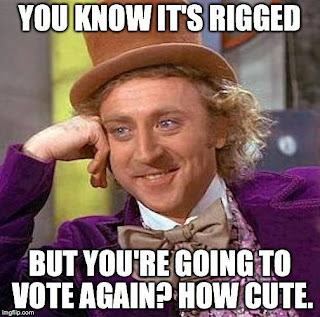
This meme reminded me of Elizabeth Warren, quoted as follows:

I did a search to fact-check this one and didn't see that it was covered live, but saw that local affiliates for ABC and NBC did cover the story. From what I could find in my searching, I didn't see that it was covered live. To be fair, I'm not sure that anyone else is getting priority over other programming that generates revenue. You know, like CSI.
Then I see that the Democratic National Committee has abruptly changed their rules on debates. The DNC claims that:
All of this could probably be dismissed as just a coincidence. But I do find it interesting that even though Trump has admitted that he is willing to raise taxes on himself, that no other GOP candidates admit the same. Trump has also admitting giving more money to Democrats than to Republicans. He seems to have a rather murky history in terms of his sincerity to the GOP. Yet he's still getting the lion's share of press coverage of all the candidates for president.
And then there is the Super Delegate problem for Bernie. In the Democrat nomination process, there is a rather large fraction of delegates that can vote their conscience rather than vote for who is elected through the primary process. It's not the most democratic way to select the nominee, but I guess someone had to put the brakes on any populism that might happen to break out within the party.
Sanders is filling stadiums left and right. Often, he has to move to bigger venues due to their consistent underestimation of the crowds attending. He's not getting much major media press, but the Internet loves him. Sanders could be the first president elected without any major media attention leading up to the primaries and the convention, just with internet support.
But if he's not nominated, the system is going to get a lot more scrutiny, if not ring a few alarm bells.

This meme reminded me of Elizabeth Warren, quoted as follows:
"Let's just be real clear - the game is rigged and it's rigged in favor of those who have money and who have power," Warren said in an interview on "CNN Tonight."
"Watch what happens in Wall Street. If you can hire an army of lobbyists and an army of lawyers then you get what you need out of Washington - Washington will make sure that the rules work for you," she said.In response to Bernie Sanders, I see that the opposition is marshalling their forces. In the press, we see that none of his grand events are being televised live. The Washington Post has done some very interesting analysis of media coverage and found that Trump is surging because the media prefers to cover him:
Donald Trump’s surge to the front of the GOP presidential polls has occasioned not a little media attention and endless speculation as to why. You can disregard most of that speculation. The answer is simple: Trump is surging in the polls because the news media has consistently focused on him since he announced his candidacy on June 16.There is a chart embedded in that article showing the share of attention given to Trump at the expense of the other candidates, including Bernie Sanders. This not a conspiracy theory in the context of media ownership. Remember, 6 parent companies own 90% of the major media. Captured in this meme is one result of that ownership:

I did a search to fact-check this one and didn't see that it was covered live, but saw that local affiliates for ABC and NBC did cover the story. From what I could find in my searching, I didn't see that it was covered live. To be fair, I'm not sure that anyone else is getting priority over other programming that generates revenue. You know, like CSI.
Then I see that the Democratic National Committee has abruptly changed their rules on debates. The DNC claims that:
While a six sanctioned debate schedule is consistent with the precedent set by the DNC during the 2004 and 2008 cycles, this year the DNC will further manage the process by implementing an exclusivity requirement. "Any candidate or debate sponsor wishing to participate in DNC debates, must agree to participate exclusively in the DNC-sanctioned process. Any violation would result in forfeiture of the ability to participate in the remainder of the debate process.In previous years there were more than 20 debates on Democrat candidates and there is now a petition in circulation to get more debates on the schedule. Many are questioning the motives behind this schedule change and the timing is rather suspect.
All of this could probably be dismissed as just a coincidence. But I do find it interesting that even though Trump has admitted that he is willing to raise taxes on himself, that no other GOP candidates admit the same. Trump has also admitting giving more money to Democrats than to Republicans. He seems to have a rather murky history in terms of his sincerity to the GOP. Yet he's still getting the lion's share of press coverage of all the candidates for president.
And then there is the Super Delegate problem for Bernie. In the Democrat nomination process, there is a rather large fraction of delegates that can vote their conscience rather than vote for who is elected through the primary process. It's not the most democratic way to select the nominee, but I guess someone had to put the brakes on any populism that might happen to break out within the party.
Sanders is filling stadiums left and right. Often, he has to move to bigger venues due to their consistent underestimation of the crowds attending. He's not getting much major media press, but the Internet loves him. Sanders could be the first president elected without any major media attention leading up to the primaries and the convention, just with internet support.
But if he's not nominated, the system is going to get a lot more scrutiny, if not ring a few alarm bells.
Thursday, August 27, 2015
Review: i-Rocks KR-6402 USB Keyboard
As a writer, I like to have a good keyboard. I look back on the many keyboards that I've had and have taken stock in the evolution of the keyboard. I learned to type on a typewriter and when I got my first computer, I began to make the transition from typing on paper to typing on screen. That transition didn't take very long.
In all the keyboards I've had in the past, the one that I used the most is this Dell keyboard. I enjoyed it because it's simple, minimalist and easy to type on. Have a look at the venerable SK-8115:

This keyboard has served me well many years on many Dell computers. I liked the compact form factor and elegant design. I was doing fine with that keyboard until someone turned me on to one of these:

Hands down, that keyboard from HP, the Elite v2 is by far the best keyboard I've ever had. My fingers just fly on it and I've enjoyed typing on them immensely. But there is a problem with them: they're wireless. I've gone through three of these in a few years. The successor, the K3500, is noisy, and probably has the same Bluetooth hardware. That hardware probably works great on Windows, but it doesn't last on Linux and I'm not sure why.
So I'd rather have a wired keyboard if wireless is going to be a problem. And away I went, looking at all kinds of keyboards to find something to replace my beloved Elite v2. Note that I still have one at work that works. But that computer is running on Windows and for obvious reasons, more effort goes into making these things work on Windows than on Linux.
After many hours of searching, I put together a short list. This keyboard wasn't on top of the shortlist and only beat out another from SIIG on price. But I like the nice aluminum finish, the short, short keystroke length, and the bounce back I get from the keys. Mind you, I've only had it for about 12 hours, but I believe that KR-6402 from i-Rocks is the next great thing, at least for me:

This new keyboard is raised a bit compared to the HP to make room for two USB ports on the side. Need to do some quick file transfers? The ports are right where you need them, one under the Escape key and the other under the email key (the top corners, left and right).
I can tell you now that aside from a slightly smaller footprint, this keyboard easily matches the response and feel from the HP Elite v2. Like anything new, it takes some getting used to, particularly the angle of the keyboard, a slight departure, but other than that, I'm happy with it so far.
This keyboard will remove any urge I have had in the past to plead with HP to make a wired version of their Elite v2. No longer will I tweet or email to HP to get the wired keyboard I wanted. I have it now.
Goodbye, HP. See you the next time I need another printer - that would be about 10 years from now.
In all the keyboards I've had in the past, the one that I used the most is this Dell keyboard. I enjoyed it because it's simple, minimalist and easy to type on. Have a look at the venerable SK-8115:
This keyboard has served me well many years on many Dell computers. I liked the compact form factor and elegant design. I was doing fine with that keyboard until someone turned me on to one of these:

Hands down, that keyboard from HP, the Elite v2 is by far the best keyboard I've ever had. My fingers just fly on it and I've enjoyed typing on them immensely. But there is a problem with them: they're wireless. I've gone through three of these in a few years. The successor, the K3500, is noisy, and probably has the same Bluetooth hardware. That hardware probably works great on Windows, but it doesn't last on Linux and I'm not sure why.
So I'd rather have a wired keyboard if wireless is going to be a problem. And away I went, looking at all kinds of keyboards to find something to replace my beloved Elite v2. Note that I still have one at work that works. But that computer is running on Windows and for obvious reasons, more effort goes into making these things work on Windows than on Linux.
After many hours of searching, I put together a short list. This keyboard wasn't on top of the shortlist and only beat out another from SIIG on price. But I like the nice aluminum finish, the short, short keystroke length, and the bounce back I get from the keys. Mind you, I've only had it for about 12 hours, but I believe that KR-6402 from i-Rocks is the next great thing, at least for me:

This new keyboard is raised a bit compared to the HP to make room for two USB ports on the side. Need to do some quick file transfers? The ports are right where you need them, one under the Escape key and the other under the email key (the top corners, left and right).
I can tell you now that aside from a slightly smaller footprint, this keyboard easily matches the response and feel from the HP Elite v2. Like anything new, it takes some getting used to, particularly the angle of the keyboard, a slight departure, but other than that, I'm happy with it so far.
This keyboard will remove any urge I have had in the past to plead with HP to make a wired version of their Elite v2. No longer will I tweet or email to HP to get the wired keyboard I wanted. I have it now.
Goodbye, HP. See you the next time I need another printer - that would be about 10 years from now.
Wednesday, August 26, 2015
Shocker! Fiber to the home adds value to the home!
Community Broadband Networks is the first place I go for news about broadband. The reason is simple, community or municipal broadband networks are the wave of the future. I like to call it "muniband" for short, but I don't know if that will ever catch on.
Anywho, Community Broadband Networks has found yet another study that shows that fiber to the home adds value to the home. In aggregate, the study found that fiber to the home has added 1.1% to the GDP of the cities with fiber, with a total value of more than $1 billion. That number may seem small in a $16 trillion economy, but fiber to the home is still relatively rare compared to copper.
For people who see home value as an indicator of economic activity, this is welcome news. For cities looking to attract jobs and businesses, this is one more brick to put into your foundation to support your argument in favor of municipal broadband with fiber to the home.
Going toe to toe, municipal broadband is cheaper and more reliable than commercial broadband. Even if private providers like Comcast or Verizon run fiber, they are still going to be more expensive than a municipal broadband service for one simple reason: community interest.
Comcast and Verizon have both shown a lack of interest in the communities they serve. The city of New York is just now waking up to the fact that Verizon is not living up to their end of the bargain when they promised fiber buildouts in exchange for preferential treatment received from that fair city. Comcast is legendary for their customer service failures and selective buildouts (I know, I still don't have Comcast here).
On the other hand, community broadband serves the community by offering service to everyone in the community. The most famous example is the Electric Power Board in Chattanooga, TN where fiber is rolled out to every address and can serve everyone in that city with a gig for $70 a month. That's a gig up and down, while legacy incumbents almost always offer asymmetrical service where the download speed is far greater than the upload speed.
Comcast has announced plans to roll out gigabit service to all subscribers by 20126. But even that will still be on copper. That means they are still a legacy incumbent service provider, unwilling to make that shift to fiber. Fiber is far more reliable than copper and is essentially future proof. It just doesn't get any faster than light.
What is interesting to note here is how hard the incumbents have been fighting higher speeds and better prices for more than a decade. They didn't really start to budge until Google Fiber made national news, but now, legacy incumbent carriers are trying to buy time with announcements of higher speeds. It's a tactic used by Microsoft called "vaporware". Promises, promises.
Not only are legacy incumbent carriers reluctant to upgrade their networks, or build out beyond their most profitable service areas, they are fighting communities that want to build their own fiber networks. Incumbents are fighting to prevent communities from adding a fiber connection to their homes with community broadband, a connection that adds value to their homes.
When legacy incumbent carriers fight municipal broadband, they are fighting the people they serve. They are working hard to prevent local self-reliance, to stunt local economies and to retard the growth of fiber to the home which can increase home values. If you own a home and love your community but would like faster, more reliable internet access, you know what I'm talking about.
If you live in a community that has community broadband, and you're connected, thank your lucky stars. If you're not connected to community broadband and you're stuck with a legacy incumbent carrier for an "ISP", then you might consider agitating for community broadband in your town. That's what I'm doing and I won't stop until I get fiber to my home from Utopia, Utah's municipal broadband carrier.
When legacy incumbent carriers fight municipal broadband while refusing to expand or improve their service, they are violating the public trust. It is up to us to revoke that trust in the legacy incumbent carriers and restore it to a carrier that serves the community rather than belittles it.
By creating community broadband services in our cities and towns, we are creating an organization that serves the community. Community broadband services are not owned by an absentee corporation. They are owned by their respective communities and as a part of that community, share a common interest to serve and to prosper.
Anywho, Community Broadband Networks has found yet another study that shows that fiber to the home adds value to the home. In aggregate, the study found that fiber to the home has added 1.1% to the GDP of the cities with fiber, with a total value of more than $1 billion. That number may seem small in a $16 trillion economy, but fiber to the home is still relatively rare compared to copper.
For people who see home value as an indicator of economic activity, this is welcome news. For cities looking to attract jobs and businesses, this is one more brick to put into your foundation to support your argument in favor of municipal broadband with fiber to the home.
Going toe to toe, municipal broadband is cheaper and more reliable than commercial broadband. Even if private providers like Comcast or Verizon run fiber, they are still going to be more expensive than a municipal broadband service for one simple reason: community interest.
Comcast and Verizon have both shown a lack of interest in the communities they serve. The city of New York is just now waking up to the fact that Verizon is not living up to their end of the bargain when they promised fiber buildouts in exchange for preferential treatment received from that fair city. Comcast is legendary for their customer service failures and selective buildouts (I know, I still don't have Comcast here).
On the other hand, community broadband serves the community by offering service to everyone in the community. The most famous example is the Electric Power Board in Chattanooga, TN where fiber is rolled out to every address and can serve everyone in that city with a gig for $70 a month. That's a gig up and down, while legacy incumbents almost always offer asymmetrical service where the download speed is far greater than the upload speed.
Comcast has announced plans to roll out gigabit service to all subscribers by 20126. But even that will still be on copper. That means they are still a legacy incumbent service provider, unwilling to make that shift to fiber. Fiber is far more reliable than copper and is essentially future proof. It just doesn't get any faster than light.
What is interesting to note here is how hard the incumbents have been fighting higher speeds and better prices for more than a decade. They didn't really start to budge until Google Fiber made national news, but now, legacy incumbent carriers are trying to buy time with announcements of higher speeds. It's a tactic used by Microsoft called "vaporware". Promises, promises.
Not only are legacy incumbent carriers reluctant to upgrade their networks, or build out beyond their most profitable service areas, they are fighting communities that want to build their own fiber networks. Incumbents are fighting to prevent communities from adding a fiber connection to their homes with community broadband, a connection that adds value to their homes.
When legacy incumbent carriers fight municipal broadband, they are fighting the people they serve. They are working hard to prevent local self-reliance, to stunt local economies and to retard the growth of fiber to the home which can increase home values. If you own a home and love your community but would like faster, more reliable internet access, you know what I'm talking about.
If you live in a community that has community broadband, and you're connected, thank your lucky stars. If you're not connected to community broadband and you're stuck with a legacy incumbent carrier for an "ISP", then you might consider agitating for community broadband in your town. That's what I'm doing and I won't stop until I get fiber to my home from Utopia, Utah's municipal broadband carrier.
When legacy incumbent carriers fight municipal broadband while refusing to expand or improve their service, they are violating the public trust. It is up to us to revoke that trust in the legacy incumbent carriers and restore it to a carrier that serves the community rather than belittles it.
By creating community broadband services in our cities and towns, we are creating an organization that serves the community. Community broadband services are not owned by an absentee corporation. They are owned by their respective communities and as a part of that community, share a common interest to serve and to prosper.
Monday, August 24, 2015
We learn by repetition, so let us learn together with compassion
I learn by repetition. I admit this freely to new acquaintances at work and in social situations. "By the way, I'm hard of hearing and I learn by repetition, so I hope you don't mind my asking your name again." Most people are very gracious when I tell them this and they don't mind when I ask their name again.
To me, the mere act of letting people know that I learn by repetition allows me the relaxation I need to learn their names. All I did was ask for help, and that in turn leads to relaxation for learning.
I bring this up because I have noticed that my children do the same things over and over again. The tread the same paths, they like to listen to the same songs, watch the same videos, say the same words or sequences of words, do the same tasks, etc, over and over again. They learn by repetition. They repeat what they do until they learn and/or become bored and find something else to do.
When I survey my own experience, I find that I get into a comfortable groove with habits and learn the processes or tasks of daily living by repetition. I make mistakes until I learn what works. I'm reminded of a friend who once told me this about standup comedy: We learn more when we bomb than when we get the laughs. I happen to agree.
So when I see people making a mistake, I let them learn from it. When ATT had all that trouble years ago with porting numbers from another carrier to their own service, I let them learn from it and remained their customer for many months afterwards. I apply this willingness to forgive to many vendors that I do business with. When they make a mistake in an ongoing business relationship, I let them learn from it. I don't terminate the business relationship for an infraction.
I do this with people, too. I've been quite forgiving of my friends throughout the years. This isn't to say that I've picked bad friends. This is to say that I want to treat people the way I want to be treated. I don't criticize my friends or loved ones for their mistakes. I give them the space to let them learn from it. I do this because I want the people most important to me to have the space they need to try again, to do better next time, to learn from their mistakes so that they learn what works. Most of all, I want those same people to give me the space I need to learn what works, too.
I turn now to love. I have a rather loose definition of love: Love is allowing others to grow to the greatest extent possible while doing no harm.
That seems so simple, but as so often in life, that simple principle is so hard to follow. We see someone do something we don't like and we feel uncomfortable with the feelings we have. So we try to change them, but that doesn't work because we can't change other people. I know, I've tried.
Now, as a father and a husband, I've had time to learn to live with others and learn to let the feelings pass - then I can take action if need be. Most of the time, I try to just let other people do what they need to do to learn. As long as they're not hurting someone else or themselves, I can just watch and ask if they need help.
There is a temptation among humans to distract ourselves or protect ourselves from our mistakes. Some people take up one form of addiction or another to lessen the pain of their mistakes. It's an easy trap to fall into because our culture encourages such activity so much.
The problem with trying to avoid the pain of our mistakes was revealed to me long ago by the following passage I once read, but cannot attribute: The lesson will be repeated until it is learned.
I found in life that I had a choice in response to mistakes. I could either avoid the situation where I noticed the mistake before or, take comfort in knowing that it's not the end of the world. I will more than likely get another chance to learn from my mistakes if I'm persistent and introspective enough to keep trying until I learn what works.
Live and let live. Let the feelings pass and then take action. Let my friends and loved ones make their mistakes and let them learn from them without criticism. They don't need any help from me to feel badly for their mistakes for, like me, they would do better if they could.
I live this way because I can't think of a better way to live.
To me, the mere act of letting people know that I learn by repetition allows me the relaxation I need to learn their names. All I did was ask for help, and that in turn leads to relaxation for learning.
I bring this up because I have noticed that my children do the same things over and over again. The tread the same paths, they like to listen to the same songs, watch the same videos, say the same words or sequences of words, do the same tasks, etc, over and over again. They learn by repetition. They repeat what they do until they learn and/or become bored and find something else to do.
When I survey my own experience, I find that I get into a comfortable groove with habits and learn the processes or tasks of daily living by repetition. I make mistakes until I learn what works. I'm reminded of a friend who once told me this about standup comedy: We learn more when we bomb than when we get the laughs. I happen to agree.
So when I see people making a mistake, I let them learn from it. When ATT had all that trouble years ago with porting numbers from another carrier to their own service, I let them learn from it and remained their customer for many months afterwards. I apply this willingness to forgive to many vendors that I do business with. When they make a mistake in an ongoing business relationship, I let them learn from it. I don't terminate the business relationship for an infraction.
I do this with people, too. I've been quite forgiving of my friends throughout the years. This isn't to say that I've picked bad friends. This is to say that I want to treat people the way I want to be treated. I don't criticize my friends or loved ones for their mistakes. I give them the space to let them learn from it. I do this because I want the people most important to me to have the space they need to try again, to do better next time, to learn from their mistakes so that they learn what works. Most of all, I want those same people to give me the space I need to learn what works, too.
I turn now to love. I have a rather loose definition of love: Love is allowing others to grow to the greatest extent possible while doing no harm.
That seems so simple, but as so often in life, that simple principle is so hard to follow. We see someone do something we don't like and we feel uncomfortable with the feelings we have. So we try to change them, but that doesn't work because we can't change other people. I know, I've tried.
Now, as a father and a husband, I've had time to learn to live with others and learn to let the feelings pass - then I can take action if need be. Most of the time, I try to just let other people do what they need to do to learn. As long as they're not hurting someone else or themselves, I can just watch and ask if they need help.
There is a temptation among humans to distract ourselves or protect ourselves from our mistakes. Some people take up one form of addiction or another to lessen the pain of their mistakes. It's an easy trap to fall into because our culture encourages such activity so much.
The problem with trying to avoid the pain of our mistakes was revealed to me long ago by the following passage I once read, but cannot attribute: The lesson will be repeated until it is learned.
I found in life that I had a choice in response to mistakes. I could either avoid the situation where I noticed the mistake before or, take comfort in knowing that it's not the end of the world. I will more than likely get another chance to learn from my mistakes if I'm persistent and introspective enough to keep trying until I learn what works.
Live and let live. Let the feelings pass and then take action. Let my friends and loved ones make their mistakes and let them learn from them without criticism. They don't need any help from me to feel badly for their mistakes for, like me, they would do better if they could.
I live this way because I can't think of a better way to live.
Saturday, August 22, 2015
Drug testing for government benefits in all the wrong places
Drug testing for welfare recipients has been a perennial charmer for conservatives in elective office. I've been hearing conservative demands for drug testing for the poor, poor beneficiaries of welfare for 3 decades now. In the last decade, they finally got their wish at the state level and it hasn't worked out quite like they planned.
Florida went through a similar adventure until the federal courts stopped them. Florida also charged welfare recipients $30-40 for the test upfront, money that would be refunded if the test was passed. 2.7% failed the test.
There are more examples we could peruse, but that is not the point of this article. The point is this: at the bottom of the housing bubble collapse were the biggest banks in America, getting emergency assistance to "save the economy" - more like "please save my sorry ass from bankruptcy!" assistance.
The bailouts consisted of approximately $16 trillion in emergency assistance, some might call this "liquidity", so that the biggest banks in America would not have to declare bankruptcy. $16 trillion? Isn't that about the size of the entire American economy for a year, you know, GDP?
Bernie Sanders was one of the men and women in Congress seeking an audit of the Fed. The purpose was to find out who got all that assistance that was so badly needed. What did we learn from that audit? We learned that many of the biggest banks got huge bailouts, despite their mistakes. Yet, no one, as far as I know, was ever tested for drugs before getting the money.
A search for drug addiction on Wall Street can yield a plethora of results like this one from The Fix website:
Remember, these Wall Street guys are "running the economy". They manage trillions in other people's money and they share the revolving door from the street to the Fed and the Treasury.
Somehow, I think testing for drugs at the welfare office is the wrong place to start. I think we should start at the Fed's emergency loan programs and the Discount Window. Welfare recipients don't tank the economy. High finance executives do.
USA Today ran an op-ed in 2012 on that very issue. Arizona tested more than 87,000 welfare recipients and found just one drug user, saving the state at least some money:
Arizona was the first state to impose a testing program. In 2009, it began testing new welfare recipients when there was a "reasonable cause" to suspect illicit drug use. So how many of the 87,000 people subjected to the program have tested positive since then?
Just one.One? The program disburses more than $200 million in aid. How much was saved by drug testing? $560.
Florida went through a similar adventure until the federal courts stopped them. Florida also charged welfare recipients $30-40 for the test upfront, money that would be refunded if the test was passed. 2.7% failed the test.
There are more examples we could peruse, but that is not the point of this article. The point is this: at the bottom of the housing bubble collapse were the biggest banks in America, getting emergency assistance to "save the economy" - more like "please save my sorry ass from bankruptcy!" assistance.
The bailouts consisted of approximately $16 trillion in emergency assistance, some might call this "liquidity", so that the biggest banks in America would not have to declare bankruptcy. $16 trillion? Isn't that about the size of the entire American economy for a year, you know, GDP?
Bernie Sanders was one of the men and women in Congress seeking an audit of the Fed. The purpose was to find out who got all that assistance that was so badly needed. What did we learn from that audit? We learned that many of the biggest banks got huge bailouts, despite their mistakes. Yet, no one, as far as I know, was ever tested for drugs before getting the money.
A search for drug addiction on Wall Street can yield a plethora of results like this one from The Fix website:
While popular culture teems with images of the coke-snorting Wall Street hot shot, the reality these days is as grim as a Florida pill mill. Like millions in society’s addicted class, hedgies are hooked on prescription pain killers.If drug use on Wall Street is so pervasive, why were there no drug tests of the beneficiaries of all that largesse in 2008? If there were drug testing for bailout bank executives, there would be howls of protests from conservatives pundits and legislators alike. But at least we'd know the state of mind of the people who were running the biggest banks when they failed.
Remember, these Wall Street guys are "running the economy". They manage trillions in other people's money and they share the revolving door from the street to the Fed and the Treasury.
Somehow, I think testing for drugs at the welfare office is the wrong place to start. I think we should start at the Fed's emergency loan programs and the Discount Window. Welfare recipients don't tank the economy. High finance executives do.
Friday, August 21, 2015
The hypocrisy of executive pay
Listen to any CEO and they'll tell you that if you keep CEO pay high, you'll attract top talent and get better performance. Unfortunately the same CEO will also tell you that "good help is hard to find", yet they will never tell you that employees perform better with less pay.
This 2009 study from the Wall Street Journal shows a very clear negative relationship between CEO pay and performance. Here is the abstract of that report:
The report goes on to say that investors often are not privy to all of the terms of the contract and therefore cannot see all of the effects of the contract. In sum, there is almost zero expectation of transparency in CEO compensation packages, preventing shareholders from determining the fair value of the contract with the CEO. The lack of transparency also allows the CEO to extracts rents from the shareholders, a fancy way of saying they steal from the shareholders.
So top tier CEO compensation doesn't correspond with performance. How about employees? Do employees perform better with a raise? There is anecdotal evidence and some studies to suggest they do, but it's more than just pay. The question seems to turn on attitudes. Does management see employees as costs or drivers of growth?
If you work at Costco, you're a driver of growth and you contribute to the bottom line. Management invests in your value as an employee with education, training, and other benefits. If you work at WalMart, well, not so much. At WalMart, you're just a liability with costs externalized to the state. Who makes a better profit? The company with happier employees empowered to do their jobs.
CEOs will often complain that good help is hard to find. They say that there is a skills gap. That there are not enough qualified people to do the job they are seeking to fill. Noted economist Dean Baker had this to say in 2012:
To put it bluntly, management often would rather support the bloated pay of the C-class with lower employee pay than to pay more money for employees that can fill the jobs and perform well. As companies like Costco and Trader Joe's have shown us, companies that pay more have happier employees and contribute to the bottom line.
Baker also offers the following point in his report:
What can we do about this condition? First, we can vote and vote progressive. Studies have shown that a lack of voter participation can lead to inequality. Second, we can support progressive candidates for office like Bernie Sanders and Elizabeth Warren. There is hope, but to hope without taking any action is futile.
Action is the magic word, for when we change our behavior, our political and economic adversaries will have no other option but to change their behavior.
This 2009 study from the Wall Street Journal shows a very clear negative relationship between CEO pay and performance. Here is the abstract of that report:
We find evidence that industry and size adjusted CEO pay is negatively related to futureSo the top 10% saw a negative return of company performance of 13%? That doesn't correlate with the line that top CEO pay attracts top CEO talent.
shareholder wealth changes for periods up to five years after sorting on pay. For example, firms that pay their CEOs in the top ten percent of pay earn negative abnormal returns over the next five years of approximately -13%. The effect is stronger for CEOs who receive higher incentive pay relative to their peers. Our results are consistent with high-pay induced CEO overconfidence and investor overreaction towards firms with high paid CEOs.
The report goes on to say that investors often are not privy to all of the terms of the contract and therefore cannot see all of the effects of the contract. In sum, there is almost zero expectation of transparency in CEO compensation packages, preventing shareholders from determining the fair value of the contract with the CEO. The lack of transparency also allows the CEO to extracts rents from the shareholders, a fancy way of saying they steal from the shareholders.
So top tier CEO compensation doesn't correspond with performance. How about employees? Do employees perform better with a raise? There is anecdotal evidence and some studies to suggest they do, but it's more than just pay. The question seems to turn on attitudes. Does management see employees as costs or drivers of growth?
If you work at Costco, you're a driver of growth and you contribute to the bottom line. Management invests in your value as an employee with education, training, and other benefits. If you work at WalMart, well, not so much. At WalMart, you're just a liability with costs externalized to the state. Who makes a better profit? The company with happier employees empowered to do their jobs.
CEOs will often complain that good help is hard to find. They say that there is a skills gap. That there are not enough qualified people to do the job they are seeking to fill. Noted economist Dean Baker had this to say in 2012:
[I]f there is a shortage of qualified workers then we should expect to see rapidly rising wages. The point here is straight-forward. If an employer wants to hire qualified workers and can’t get them by offering the current wage, then she offers a higher wage in the hope of luring qualified workers away from competitors. This is a simple example of “supply and demand.” If demand exceeds supply in typical free markets, then the price of the item should rise. In this case, an insufficient supply should mean that the wages of manufacturing workers is rising rapidly.That was back in 2012 4 years after the bottom of the recession. Wages are still flat now as they were then. What this means is that if there is a skills gap, it has almost nothing to do with the lack of skills. Anyone familiar with the travails of the STEM crowd know that having a post-graduate degree in science, technology, engineering or mathematics, will not guarantee a good paying job. What that means is that when employers complain of a skills gap, it means that they are not willing to pay enough money to fill the job.
To put it bluntly, management often would rather support the bloated pay of the C-class with lower employee pay than to pay more money for employees that can fill the jobs and perform well. As companies like Costco and Trader Joe's have shown us, companies that pay more have happier employees and contribute to the bottom line.
Baker also offers the following point in his report:
[W]e should not be blaming the workers [for the skills gap]. It is always good for people to have more skills so that they can be more productive wherever they work, but the data do not suggest that the reason so many people are out of work is because they lack skills. Instead, the real reason that they are out of work is that our policy makers have not done what’s needed to create enough jobs.The lack of demand for labor is a feature not a bug. The lack of demand for labor is a result of public policy that is written by the 1% for the 1%. The primary purpose of public policy has been, for at least the last 40 years, engineering the economy so that it will support bloated CEO pay rather than higher wages for the working class.
What can we do about this condition? First, we can vote and vote progressive. Studies have shown that a lack of voter participation can lead to inequality. Second, we can support progressive candidates for office like Bernie Sanders and Elizabeth Warren. There is hope, but to hope without taking any action is futile.
Action is the magic word, for when we change our behavior, our political and economic adversaries will have no other option but to change their behavior.
Thursday, August 20, 2015
internal vs external sources of motivation
Many years ago, I used to watch "In the Actors Studio". I was fascinated by the interviews of the famous actors I knew and loved then. They would all talk about that moment when they caught the bug. They were in an improv class, or they took an acting class in college, it was always some pivotal moment that they knew they could not do anything else for a living. I remember one actor who said that when he discovered acting, he had a firehose and he couldn't turn it off.
In reviewing the fields of study and performance, in almost every case, where we see excellence, we see people who are internally motivated. The greatest scientific minds were internally motivated. From Einstein to Darwin to Salk, the greatest scientists of history were all motivated by their own desire to know, to excel, to discover, to share.
In a similar vein, all of the greatest athletes were and are internally motivated. They practice, they compete, they study their craft. And with actors, they study, they compete (in the auditions), and they act. It is hard to find an example of excellence that is not internally motivated.
A simple cautionary sentence comes to mind. "If you're doing it for the money, you're doing it for the wrong reasons". I was a sheet metal worker for ten years. I did it for the money and I just could not keep doing it. My mind would not let me. So I got into IT. Then I got into writing and found my passion. I love IT, so don't get me wrong. I'm very good at it, but that work takes real effort. Writing is a talent. IT is a skill. Some people have a talent for IT. I'm not one of them. I have a skill for IT, but it's not my talent.
Skills and talents both require practice, but both come from internal motivation to perform. There is a song called "I Hate Mondays". It's about work and as a part of our culture, shows us how many people hate their jobs. I don't wake up on Monday and say that I hate that day. I wake up for work, even IT work and I never say that I hate my job. I enjoy my job because I find something to enjoy about it. I like to get to work early so that I'm prepared for the day. I enjoy solving technical problems. I enjoy helping other people. I enjoy the satisfaction of work well done.
There is another phrase that comes to mind: "You can't change people". This is the clincher. I have beat my head on this one many times to no avail. I've got enough bumps now and can move on. Now I just pray because the reality is, that's about all I can do now that I know that motivation to change must come from the inside.
When I see people suffer, or adapt to people that cause suffering in my life, I remind myself that I can't change them. I simply cannot provide motivation for others to change. I can only change myself and redirect my motivation somewhere else. But I can pray for them. Take note here, I'm not religious. I don't subscribe to any religion. But I have noticed the power of prayer and have faith in the existence of a power greater than myself, like the sun or the Universe. My tiny little brain is simply no match for the universe, so I pray to get along with it.
When I interact with children, particularly my own, I have no illusion that I can motivate them to do anything. I simply don't the power to be their motivation to do anything or all things. Whatever children want to do, that comes from inside, not from me. If it turns out that they're intelligent, charming, or nice, that's all them, not me. I just provide the environment for them to be that way. I can't change them.
When dealing with misbehavior, I remind myself that my goal is to find the problem they're trying to solve with their behavior and help them to solve it. Kids act out when they cannot find the skills they need to respond to the demands of their environment. It is up to us to teach them the skills they need to respond. No amount of punishment or threat of punishment can change them. That can repress the behavior, but punishment doesn't solve the underlying problem which is the lack of skills to respond to the demands of the environment.
I assume that kids would do better if they could, if they had the skills to respond to their environment, they would. I assume that the motivation is there inside to do better. Now because of my own upbringing, I may forget that from time to time, but the vast majority of the time, I'm on track. I want my kids to find their own motivation in life.
The reason for this is simple. I can't be there for them all the time, 24x7. So I do my best to live the example. I do my best to be the person I would like them to be. I use my own motivation to do that, and to let them use their own motivation to do what they do.
I have since learned to apply this to adults. Adults would do better if they would. I learned this rather late in life having taken some rather deep detours as a result of my upbringing. Everyone is pretty much the same. When people do not have the skills to respond to the demands of their environment they act out. People commit crimes because they lack the skills to adapt or respond to their surroundings. If they had the skills to respond, they would.
Living in peace is a skill. This is all that I want to teach. We can learn this skill together.
In reviewing the fields of study and performance, in almost every case, where we see excellence, we see people who are internally motivated. The greatest scientific minds were internally motivated. From Einstein to Darwin to Salk, the greatest scientists of history were all motivated by their own desire to know, to excel, to discover, to share.
In a similar vein, all of the greatest athletes were and are internally motivated. They practice, they compete, they study their craft. And with actors, they study, they compete (in the auditions), and they act. It is hard to find an example of excellence that is not internally motivated.
A simple cautionary sentence comes to mind. "If you're doing it for the money, you're doing it for the wrong reasons". I was a sheet metal worker for ten years. I did it for the money and I just could not keep doing it. My mind would not let me. So I got into IT. Then I got into writing and found my passion. I love IT, so don't get me wrong. I'm very good at it, but that work takes real effort. Writing is a talent. IT is a skill. Some people have a talent for IT. I'm not one of them. I have a skill for IT, but it's not my talent.
Skills and talents both require practice, but both come from internal motivation to perform. There is a song called "I Hate Mondays". It's about work and as a part of our culture, shows us how many people hate their jobs. I don't wake up on Monday and say that I hate that day. I wake up for work, even IT work and I never say that I hate my job. I enjoy my job because I find something to enjoy about it. I like to get to work early so that I'm prepared for the day. I enjoy solving technical problems. I enjoy helping other people. I enjoy the satisfaction of work well done.
There is another phrase that comes to mind: "You can't change people". This is the clincher. I have beat my head on this one many times to no avail. I've got enough bumps now and can move on. Now I just pray because the reality is, that's about all I can do now that I know that motivation to change must come from the inside.
When I see people suffer, or adapt to people that cause suffering in my life, I remind myself that I can't change them. I simply cannot provide motivation for others to change. I can only change myself and redirect my motivation somewhere else. But I can pray for them. Take note here, I'm not religious. I don't subscribe to any religion. But I have noticed the power of prayer and have faith in the existence of a power greater than myself, like the sun or the Universe. My tiny little brain is simply no match for the universe, so I pray to get along with it.
When I interact with children, particularly my own, I have no illusion that I can motivate them to do anything. I simply don't the power to be their motivation to do anything or all things. Whatever children want to do, that comes from inside, not from me. If it turns out that they're intelligent, charming, or nice, that's all them, not me. I just provide the environment for them to be that way. I can't change them.
When dealing with misbehavior, I remind myself that my goal is to find the problem they're trying to solve with their behavior and help them to solve it. Kids act out when they cannot find the skills they need to respond to the demands of their environment. It is up to us to teach them the skills they need to respond. No amount of punishment or threat of punishment can change them. That can repress the behavior, but punishment doesn't solve the underlying problem which is the lack of skills to respond to the demands of the environment.
I assume that kids would do better if they could, if they had the skills to respond to their environment, they would. I assume that the motivation is there inside to do better. Now because of my own upbringing, I may forget that from time to time, but the vast majority of the time, I'm on track. I want my kids to find their own motivation in life.
The reason for this is simple. I can't be there for them all the time, 24x7. So I do my best to live the example. I do my best to be the person I would like them to be. I use my own motivation to do that, and to let them use their own motivation to do what they do.
I have since learned to apply this to adults. Adults would do better if they would. I learned this rather late in life having taken some rather deep detours as a result of my upbringing. Everyone is pretty much the same. When people do not have the skills to respond to the demands of their environment they act out. People commit crimes because they lack the skills to adapt or respond to their surroundings. If they had the skills to respond, they would.
Living in peace is a skill. This is all that I want to teach. We can learn this skill together.
Tuesday, August 18, 2015
How Citizens United might benefit the liberal cause - with a caveat
I love replies to my blog posts. When I get a reply (which isn't very often *sob!*) I find interesting and compelling new information that helps me to check my facts, that provides informative insight that I had not considered before and that, at the very least, provides some proof that people are actually reading my blog. I really do enjoy the replies, so please feel free to respond to any and all.
Today, I'd like to share with you an article sent to me by Eric C. Jacobson, Public Interest Lawyer. He responded to my post, Let Trump feed the GOP these words, "money is speech", with a very interesting and very well informed perspective on Citizens United. Further, he says that there are liberal billionaires out there who are willing to support liberal causes with their money and that Citizens United frees their hand where it was not free before. He provides several very good examples of such people, billionaires who are sympathetic to the liberal cause and that are willing to throw their money into the race.
Mr. Jacobson does a masterful job of laying out the history that is the backdrop of this presidential campaign. In his article he has brought forth the reserved vitriol I would expect from an attorney, and does so with a certain poetic flair. His article is quite informative and provides a unique perspective on how the 1% amassed their power and how they have taken their toll on the middle class. He also provides an ominous warning that only the well-funded candidates win the presidency.
I found his article most instructive with the following passage:
While I applaud Mr. Jacobson's efforts to promote Bernie Sanders, I must admit having somewhat mixed feelings about his efforts with the SuperPAC he created. I'm not here to denigrate him or his SuperPAC for I want Bernie to win, too. It may well be that we need this SuperPAC to provide the outlet that liberal billionaires need to put their money where it will best support Bernie.
But I have several concerns that should ultimately be addressed sooner or later, but they must be addressed. I offer the following with the utmost respect for Mr. Jacobson. First off is the fact that Bernie is not just running a campaign for election to the highest office in the land. He is the head of a social movement to address the injustices of institutionalized inequality in all areas of life, not just economic policy. That movement is a movement of ideas, not money.
Second, as I've noted in my blog previously, billionaires make their money from businesses, often large private monopolies that provide products or services with few if any alternatives. When profits from those businesses are used as political contributions, the customers of those businesses become unlikely and perhaps unwitting supporters of politics they would never support. This why I promote and support candidates like Bernie Sanders and the SuperPAC to end all SuperPACs, mayday.us.
There is one last point I want to make. The reason we have such deep corruption in our government, at nearly every level is this pervasive sense of entitlement that the wealthy have. When the wealthy make a political contribution, they have a reasonable expectation of getting something in return. This sense of entitlement that I speak of is in direct conflict with every ideal of democracy.
There is no question that we must fight fire with fire. But fire is a dangerous servant and a terrible master. I believe that our democracy, like others before it, must decide what is more important, money or ideas. If we go with the money our democracy is almost surely lost. The only way to save our democracy is for our elected representatives to be dependent on the people alone. All of them.
Today, I'd like to share with you an article sent to me by Eric C. Jacobson, Public Interest Lawyer. He responded to my post, Let Trump feed the GOP these words, "money is speech", with a very interesting and very well informed perspective on Citizens United. Further, he says that there are liberal billionaires out there who are willing to support liberal causes with their money and that Citizens United frees their hand where it was not free before. He provides several very good examples of such people, billionaires who are sympathetic to the liberal cause and that are willing to throw their money into the race.
Mr. Jacobson does a masterful job of laying out the history that is the backdrop of this presidential campaign. In his article he has brought forth the reserved vitriol I would expect from an attorney, and does so with a certain poetic flair. His article is quite informative and provides a unique perspective on how the 1% amassed their power and how they have taken their toll on the middle class. He also provides an ominous warning that only the well-funded candidates win the presidency.
I found his article most instructive with the following passage:
A lost footnote to history (a highly important one) is the established FACT that “campaign finance reform” laws were first proposed during the Nixon administration in 1969 as a CONSERVATIVE response to Eugene McCarthy’s electoral insurgency. The proponents were Congressional incumbents who wanted to make it harder for challengers to acquire the funds realistically needed to get their alternative messages out to the voters.Here, Mr. Jacobson sets up his main point that Citizens United has freed the hands of all billionaires to contribute to their campaigns of favor, especially the liberal billionaires by neutering certain campaign finance laws. Mr. Jacobson has even set up a SuperPAC dedicated to the sole purpose of giving the Bernie Sanders for President campaign a serious lift.
While I applaud Mr. Jacobson's efforts to promote Bernie Sanders, I must admit having somewhat mixed feelings about his efforts with the SuperPAC he created. I'm not here to denigrate him or his SuperPAC for I want Bernie to win, too. It may well be that we need this SuperPAC to provide the outlet that liberal billionaires need to put their money where it will best support Bernie.
But I have several concerns that should ultimately be addressed sooner or later, but they must be addressed. I offer the following with the utmost respect for Mr. Jacobson. First off is the fact that Bernie is not just running a campaign for election to the highest office in the land. He is the head of a social movement to address the injustices of institutionalized inequality in all areas of life, not just economic policy. That movement is a movement of ideas, not money.
Second, as I've noted in my blog previously, billionaires make their money from businesses, often large private monopolies that provide products or services with few if any alternatives. When profits from those businesses are used as political contributions, the customers of those businesses become unlikely and perhaps unwitting supporters of politics they would never support. This why I promote and support candidates like Bernie Sanders and the SuperPAC to end all SuperPACs, mayday.us.
There is one last point I want to make. The reason we have such deep corruption in our government, at nearly every level is this pervasive sense of entitlement that the wealthy have. When the wealthy make a political contribution, they have a reasonable expectation of getting something in return. This sense of entitlement that I speak of is in direct conflict with every ideal of democracy.
There is no question that we must fight fire with fire. But fire is a dangerous servant and a terrible master. I believe that our democracy, like others before it, must decide what is more important, money or ideas. If we go with the money our democracy is almost surely lost. The only way to save our democracy is for our elected representatives to be dependent on the people alone. All of them.
Monday, August 17, 2015
The facade of the free market in global labor
When asked, our leaders will proudly tell us how we must compete globally. They will tell us how we must demonstrate the virtues of the free market here and abroad. They tell us that we must innovate and invent to compete in the world market.
Here's what they don't tell you: labor markets in other parts of the world are not free. I found a very interesting example of that here, at the Films for Action website. It's a nice short film documenting the labor struggle in Cambodia. When workers in garment factories ask for a decent wage, they are denied. When they protest, the government intervenes on behalf of the businesses that employ the workers.
Sounds familiar, right? We had something similar here, though not as extreme, when Ronald Reagan fired all of the air traffic controllers in 1981 when they went on strike. Since then, we've witnessed an unrelenting war on organized labor in the United States. The result? In the 1970s, unions represented 34% of labor. Now it's about 9%. Much of this shift is due to government support of businesses, not labor.
The use of government force against organized labor is not a new phenomenon. It's been going on for centuries. We're just seeing it again, in Cambodia as we do here. Lately, we've been seeing more labor protests in this country as more and more people begin to notice that the playing field is tilted in favor of business, by design. We have been fortunate that labor protests have been peaceful to the extent that they have been.
That short film was produced by Labour Behind the Label an organization dedicated to improving workplace conditions for workers worldwide. They work to improve wages, working conditions and respect for the rights of workers, all over the world. They also work to expose the exploitation of workers worldwide. They show us that while absentee corporations in foreign companies pay fantastic salaries to executives living in wealthy countries like the US and the UK, they are not paying a living wage to their sources of labor. Remember, the US and the UK are the two biggest promoters of "free trade agreements".
Which companies are participating in the exploitation of garment workers around the world? Here is their list of companies that benefit the most from wage suppression in Cambodia. It is interesting to note that Versace and Armani are at the top of the bad-boy list. These firms sell very expensive clothes yet pay a pittance for their labor. I note also that Adidas, New Balance, Puma and Levi-Strauss are on the list.
I happen to like New Balance shoes. They're great shoes, and I enjoy wearing them. Unfortunately, when I paid for the shoes, I also paid for their politics. Worldwide.
The Clean Clothes Campaign is a network of 250 organizations worldwide, seeking a living wage for garment makers. Their website says it all. Workers all over the world are seeking a living wage, just as we are here, too. But I notice a common denominator in every country: where there is a struggle for a living wage, there is a government standing firmly on the side of business. Big business.
Yet we are told that capitalism is the foundation for a free market. Well, if a free market is what you want, then you must accept these protests, unions and negotiations as a part of that free market. Unions are a natural response to suppressed wages in a supposedly free market. Unions are a part of the free market, so get over it and deal, because that's never going to change. If businesses can organize, consolidate and coordinate their efforts with interlocking directorates, then labor can organize, too. What's fair is fair, right?
So the next time you're out buying clothes, remember that the price of the clothes includes the cost of struggle of the people who make those clothes. That cost includes government intervention in the market to suppress wages, unions and media coverage of that struggle.
That cost is the facade of the free market in global labor.
Sunday, August 16, 2015
Low voter turnout predicts inequality
For decades we've been hearing the mantra, "Get out the vote", and for decades, we've been seeing the numbers showing a slow, steady decline in voter participation. In the last mid-term election we saw the lowest voter participation rate since World War II. That long, slow decline extends over 70 years and is more pronounced starting in the 70s. Voter participation trends right along with inequality over the last 40 years.
Add to that a variety of efforts to stifle or suppress voter participation and you have a recipe for banana-republic-strength inequality. For the proponents of voter suppression laws, I have to wonder, at what point will voter participation be low enough?
This relationship between voter participation and income inequality has been proven in at least one natural experiment in Argentina after compulsory voting was abolished. As voter turnout decreased over the years, income inequality increased.
In the United States (the other natural experiment), voting is voluntary, not mandatory. Given our experience, if we do not vote, we are essentially giving our money and our power to someone else. That someone else is usually someone with more money and power, someone with the willingness to make the time to vote. Then that someone else will write the laws, get the benefits, and send our kids to war.
If there was ever a reason to vote, inequality is the most important reason. Forget everything you know about civic duty and remember that politicians listen to the money first. They're going to blow $5 billion on a presidential election to get someone in the White House in 2016. Someone is expecting a return on their investment. We might as well have a say in this election, right?
No matter how much money they spend, the people in power have to justify the outcome with votes. The powerful cannot just manufacture consent, though they love to try. People are watching, and consent is hard to get if there is suspicion or even evidence of fraud at the polls.
Yes, it is true that many people think that their vote doesn't count, but it does. Every vote counts. Just ask B-1 Bob Dornan. Elected officials need to show that there are votes and that they are being counted honestly. They need to show that the winners were elected, fair and square. For if they do not, there will be unrest, protests and perhaps a change of government.
If we truly believe that inequality is the bane of democracy, then the antidote is the vote. When we are all heard, we can reverse the trend of inequality and bring about an economy that works for all of us.
Add to that a variety of efforts to stifle or suppress voter participation and you have a recipe for banana-republic-strength inequality. For the proponents of voter suppression laws, I have to wonder, at what point will voter participation be low enough?
This relationship between voter participation and income inequality has been proven in at least one natural experiment in Argentina after compulsory voting was abolished. As voter turnout decreased over the years, income inequality increased.
In the United States (the other natural experiment), voting is voluntary, not mandatory. Given our experience, if we do not vote, we are essentially giving our money and our power to someone else. That someone else is usually someone with more money and power, someone with the willingness to make the time to vote. Then that someone else will write the laws, get the benefits, and send our kids to war.
If there was ever a reason to vote, inequality is the most important reason. Forget everything you know about civic duty and remember that politicians listen to the money first. They're going to blow $5 billion on a presidential election to get someone in the White House in 2016. Someone is expecting a return on their investment. We might as well have a say in this election, right?
No matter how much money they spend, the people in power have to justify the outcome with votes. The powerful cannot just manufacture consent, though they love to try. People are watching, and consent is hard to get if there is suspicion or even evidence of fraud at the polls.
Yes, it is true that many people think that their vote doesn't count, but it does. Every vote counts. Just ask B-1 Bob Dornan. Elected officials need to show that there are votes and that they are being counted honestly. They need to show that the winners were elected, fair and square. For if they do not, there will be unrest, protests and perhaps a change of government.
If we truly believe that inequality is the bane of democracy, then the antidote is the vote. When we are all heard, we can reverse the trend of inequality and bring about an economy that works for all of us.
Friday, August 14, 2015
4 hours of TV a day does not a democracy make
According to the Bureau of Labor Statistics, Americans spent an average of 2.8 hours a day watching TV in 2014:
4 hours a day is 28 hours a week. That's almost a part time job, just watching TV, keeping up with current events and tracking plots of the shows that people want to watch. For men, most of that is probably sports, given the way ESPN likes to get it's lineup tacked onto the basic cable package.
Watching TV, despite what we might think, takes a lot of effort. To watch TV, the viewer has to sit still long enough to get enjoyment from the programming. They have to time their potty breaks if they are not time-shifting. Time-shifting is recording programs for later viewing and it's a common practice. Then what happens on TV is committed to memory for discussion later with friends and family.
4 hours of TV a day would explain why some people who run for president are preparing to spend one billion and more on their campaigns for 2016. Air time is expensive. From production to the air, it all costs money. If we can reasonably expect most people to watch 4 hours a day, then we can expect that someone is going to see a commercial for a leading candidate for president.
The sad part is, many people make decisions based on what they see on TV. For example, it is plausible that many people make a decision to buy toilet paper based on the opinions expressed by two animated bears. Um, what exactly do they do in the woods again? If TV can sell toilet paper, it can sell a presidency.
That 4 hours of television time is time that could be spent pursuing a trade or formal education, raising a family, running a business or, God forbid...participating in civic life. If people would rather stay home and watch TV than to get off their but and vote, we have a problem.
Maybe that's the point of TV.
We now have the ability to educate and inform ourselves with the internet. We can watch just about anything we want to watch on YouTube, Netflix, Vimeo and a plethora of other online video services. We can research every candidate for their funding, their statements and their votes. We can check to see if they are philosophically and ideologically consistent. We might even be able to determine if they work for us or not.
So even if we see it on TV, we can still fact-check our candidates. We can determine if their actions are consistent with our desires of how a government should be run. As more and more people cut the cord, we can have a reasonable expectation that Americans will become more literate, more capable of discerning the issues from the candidates, and whether or not the candidates are representing our interests. As Americans cut the cord, they will have to learn how to use the internet to get the information they want.
That might mean having to spend less time watching TV and more time learning to live in a connected society. That might mean we spend more time learning how to use other sources than major media to form our opinions about who should sit in the White House.
Watching TV was the leisure activity that occupied the most time (2.8 hours per day), accounting for more than half of leisure time, on average, for those age 15 and over. Socializing, such as visiting with friends or attending or hosting social events, was the next most common leisure activity, accounting for 43 minutes per day.Norman Herr, Ph.D, professor of Science Education at California State University, Northridge, has compiled a number of interesting statistics on American life, including this one:
According to the A.C. Nielsen Co., the average American watches more than 4 hours of TV each day (or 28 hours/week, or 2 months of nonstop TV-watching per year). In a 65-year life, that person will have spent 9 years glued to the tube.Perhaps Nielsen has an optimistic bias in favor of TV, but if they are right, 9 years is a long time to spend watching TV. Between the two of those sources, we're looking at 2.8-4 hours a day of just sitting and watching TV. That just boggles my mind. For the purpose of this blog post, let's assume that Nielsen is right since their sole purpose is to capture data on how we use TV and other devices as a business model.
4 hours a day is 28 hours a week. That's almost a part time job, just watching TV, keeping up with current events and tracking plots of the shows that people want to watch. For men, most of that is probably sports, given the way ESPN likes to get it's lineup tacked onto the basic cable package.
Watching TV, despite what we might think, takes a lot of effort. To watch TV, the viewer has to sit still long enough to get enjoyment from the programming. They have to time their potty breaks if they are not time-shifting. Time-shifting is recording programs for later viewing and it's a common practice. Then what happens on TV is committed to memory for discussion later with friends and family.
4 hours of TV a day would explain why some people who run for president are preparing to spend one billion and more on their campaigns for 2016. Air time is expensive. From production to the air, it all costs money. If we can reasonably expect most people to watch 4 hours a day, then we can expect that someone is going to see a commercial for a leading candidate for president.
The sad part is, many people make decisions based on what they see on TV. For example, it is plausible that many people make a decision to buy toilet paper based on the opinions expressed by two animated bears. Um, what exactly do they do in the woods again? If TV can sell toilet paper, it can sell a presidency.
That 4 hours of television time is time that could be spent pursuing a trade or formal education, raising a family, running a business or, God forbid...participating in civic life. If people would rather stay home and watch TV than to get off their but and vote, we have a problem.
Maybe that's the point of TV.
We now have the ability to educate and inform ourselves with the internet. We can watch just about anything we want to watch on YouTube, Netflix, Vimeo and a plethora of other online video services. We can research every candidate for their funding, their statements and their votes. We can check to see if they are philosophically and ideologically consistent. We might even be able to determine if they work for us or not.
So even if we see it on TV, we can still fact-check our candidates. We can determine if their actions are consistent with our desires of how a government should be run. As more and more people cut the cord, we can have a reasonable expectation that Americans will become more literate, more capable of discerning the issues from the candidates, and whether or not the candidates are representing our interests. As Americans cut the cord, they will have to learn how to use the internet to get the information they want.
That might mean having to spend less time watching TV and more time learning to live in a connected society. That might mean we spend more time learning how to use other sources than major media to form our opinions about who should sit in the White House.
Wednesday, August 12, 2015
The first act of the next Congress should be The Citizen Equality Act of 2017
More on Larry Lessig today. As I noted yesterday, Lessig is (and has been for many years) making a very significant contribution to the question of our elections and how they are run. He has a new video (2.5 min) and webpage which describe The Citizen Equality Act of 2017, an act to make it easier for everyone to vote and to reduce or eliminate the influence of big money on politicians.
The ideas proposed by Lessig spring from a concept from Federalist Paper #52. That concept is that there should be a branch of government that is dependent upon the people alone. This is what the Framers of the Constitution had in mind. They did not want a legislature that was dependent upon the money from a privileged few, they wanted the legislature to be dependent upon all of us, The People.
That means 3 really big things:
Lessig is also considering a run for president, but this late in the game, I'm not so sure that he's a viable candidate. I think he'd be great as commissioner of the Federal Election Commision in Bernie Sanders' cabinet. His ideas are sound and they build off of ideas proposed by seasoned politicians who know our elections have gone off the rails.
It's worth noting that Sanders has just introduced a bill to make Election Day a holiday. Now we get to see who would be against that idea. In the same vein, Lessig makes an interesting point. As he stated in his video, "We're putting together a package that together would create a meaningful political equality for all American citizens. That commitment to equality should not be controversial in American. But if it is, then let's have that fight on these terms. Let us defend the idea of equal citizens and let those who oppose it explain why they're against it."
The ideas proposed by Lessig spring from a concept from Federalist Paper #52. That concept is that there should be a branch of government that is dependent upon the people alone. This is what the Framers of the Constitution had in mind. They did not want a legislature that was dependent upon the money from a privileged few, they wanted the legislature to be dependent upon all of us, The People.
That means 3 really big things:
- Equal right to vote. That means that every citizens has a guaranteed right to vote. That also means automatic registration and moving election day to a public holiday so everyone has a chance to vote.
- Equal representation. That means an end to gerrymandering so that there are no more safe seats in Congress or our statehouses.
- Citizen funded elections. Every voter gets a voucher to use for campaign contributions or matching funds for small contributions. There would be an anti-corruption act to remove the connection between money and time in prison lying in wait for those who persist with the old way. Then we can also make sure the revolving door would be shut.
Lessig is also considering a run for president, but this late in the game, I'm not so sure that he's a viable candidate. I think he'd be great as commissioner of the Federal Election Commision in Bernie Sanders' cabinet. His ideas are sound and they build off of ideas proposed by seasoned politicians who know our elections have gone off the rails.
It's worth noting that Sanders has just introduced a bill to make Election Day a holiday. Now we get to see who would be against that idea. In the same vein, Lessig makes an interesting point. As he stated in his video, "We're putting together a package that together would create a meaningful political equality for all American citizens. That commitment to equality should not be controversial in American. But if it is, then let's have that fight on these terms. Let us defend the idea of equal citizens and let those who oppose it explain why they're against it."
Subscribe to:
Posts (Atom)